

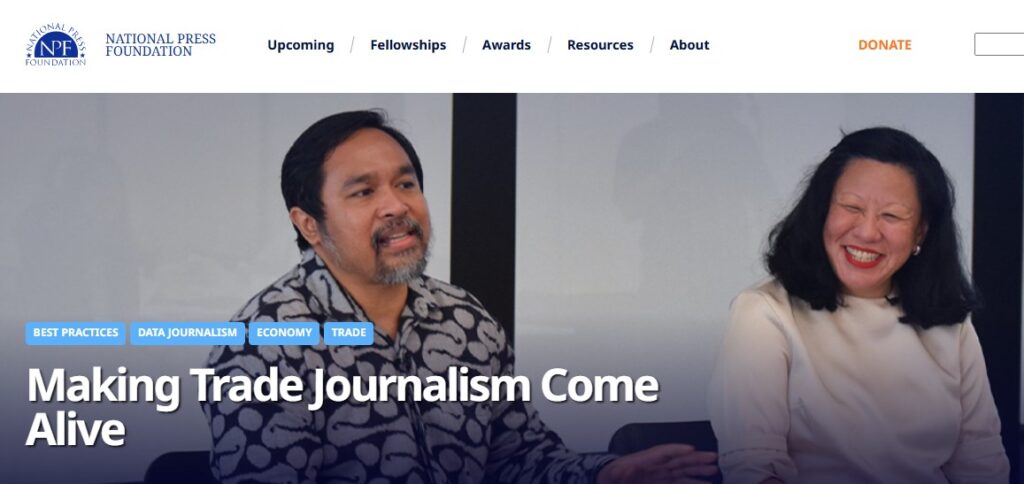
I participated as a fellow in the International Trade Training for Journalists in Asia 2023, organized by the National Press Foundation (NPF) and the Hinrich Foundation, held in Singapore. On August 11, 2023, we had a discussion on “Writing for the Public Interest” focusing on how combining data with real people’s stories makes trade journalism more compelling. This session was led by Su-Lin Tan of the South China Morning Post and Wahyu Dhyatmika of Tempo Digital, Indonesia.
During the discussion, I shared my thoughts and examples of investigative stories I have worked on. One phrase I shared that reflects the core of my reporting was:
“Everybody knows, nobody knows” — my own words.
Details Q & A bellow;
Sushanta Singha (38:34):
Oh, I’m Sushanta Singha. I’m from Bangladesh, a television reporter. I work for television, and I love to use statistics. You said that public interest—you have to mention first that we care about public interest. As a student of journalism, I think every journalist, if they do a story, it goes to public interest. Without public interest, there is nothing.
Nowadays we are hearing about public interest journalism, mobile journalism, data journalism—many such terms are going around. But I think journalism is journalism. If I do a story, it creates some public interest, and also the policymakers can change their policy.
Like, one issue I should mention here. In 2018–19, Bangladesh Bank, our central bank, gave data that we had earned $37.5 billion in export earnings. In 2020, they reported the same data: Bangladesh earned $37.5 billion. But in 2021, they published data showing a change—it went down to $33.5 billion. Almost $2 billion is…?
(39:56)
Nobody knows. Everybody knows. When I made the story, Bangladesh Bank said, “We are working on it.”
You can imagine—this is the money that does not go to freight costs. This is the export received by Bangladesh. So how can you change financial data after two years? When I made this story, it created some problems also, because Bangladesh Bank—last year I made the story—and we are facing severe issues with foreign currency reserves. That’s why the $2 billion is a big deal, because Bangladesh is going to the IMF for $5 billion. It’s almost half of that money.
(40:39)
Another issue I want to raise is about public interest. The public is involved, but they don’t have the interest. Like cigarette smokers—Bangladesh is one of the highest smoking countries in the world. Every day, 20 crore Bangladeshi Taka—meaning 200 million Taka—is being taken from people above the printed price on the cigarette packets. Each stick is being sold at one Taka more.
So if you calculate, 20 crore daily means in a year, they are taking 7,000 crore Taka.
(41:22)
That means if you equal it to 100 Taka per US dollar in Bangladeshi currency, it goes to billions of dollars being taken from people. But nobody bothers. But I made that story. At that time, the National Board of Revenue took action and changed the policy. Now, every product must have the price tag printed on the packet, and they should not sell beyond this price.
(41:53)
Why am I telling you these two stories made by me? Because the public is involved, but they don’t bother. Everyone is smoking, but they’re paying much more money. But educated people, when they go outside the [inaudible 00:42:10], if someone charges them extra, they argue. So that is the issue. I think journalism is the main issue, apart from all these other phenomena. Thank you.
Su-Lin Tan / South China Morning Post (42:26):
That’s great. Everybody knows, and nobody knows.
Wahyu Dhyatmika / Tempo Digital (42:28):
“Everybody knows, nobody knows.” “Public involved but not interested.” Very good quotes. I think I know your question will trigger a lot of discussion.
This is part of a long debate in our profession, and I think it needs a lot more contribution and effort from all of us to make sure that the industry—the press, the news media industry—moves in the right direction. Because now, there are a lot of other forces that try to redefine journalism. And I think that’s why the term “public interest journalism” has become more and more cited recently—because we need to emphasize that real journalism is public interest journalism.
Other forms of publishing stories are sometimes not really journalism, and we need to say it upfront: that’s not journalism.
(43:24)
And I totally agree with you—sometimes the public is not really interested. But I would say that you need to see the audience or public in broader terms. It has segments. So even though the general public might not read or click your stories, if you can get the authorities, decision-makers, or members of parliament to care about the story and act on it, I think that’s also worth it.
Su-Lin Tan / South China Morning Post (44:00):
I wonder if I could brainstorm your story for a second. When you looked at the numbers and saw the discrepancies, what was your starting point? Did you have a contact inside the government who was able to give you more information about how that money—the dollars—was being taken from the people? What was your starting point?
Sushanta Singha (44:24):
To get pricing?

Su-Lin Tan / South China Morning Post (44:27):
Yes. Yes. Let’s brainstorm this. We might as well make this a practical session; otherwise it’s just all theory. So, yeah, go on.
Sushanta Singha (44:34):
Besides my journalistic job, I also do research on tobacco control and public health issues. I’ve been doing so for the last 10 years.
When I did the research and talked to traders—small shopkeepers and vendors—they said, “We are taking extra money from the people beyond what the pricing is printed.” The price is fixed by the government. Only cigarette products in Bangladesh are priced by the government, specifically the National Board of Revenue. They fix the price with all kinds of taxes included. This is a high-tax item, and that price is printed on the package. That is the government’s issue because they calculate the tax.
Su-Lin Tan / South China Morning Post (45:25):
So you noticed that the shop sellers were actually taking, say, 20 Taka, and then charging an extra Taka?
Sushanta Singha (45:33):
Yes.
Su-Lin Tan / South China Morning Post (45:34):
And no one’s checking the labeling on the… okay. And then what happened?
Sushanta Singha (45:39):
Then I asked them, “Why are you taking extra money?” They showed me the money trail. They said it’s for the dealer or the agent of the cigarette company. The dealer brought the cigarettes at the fixed price printed on the box—270 Taka per 10 or 26 sticks. But traders were purchasing cigarettes at the printed price.
Su-Lin Tan / South China Morning Post (46:15):
The company was actually telling them what to—
Sushanta Singha (46:17):
The company is actually liable, because they should be giving a trade discount to wholesalers and retailers. But they don’t do that. So the traders end up selling the cigarette at the printed price plus more.
Su-Lin Tan / South China Morning Post (46:35):
Right. Plus more.
Sushanta Singha (46:37):
And the traders, needing to make a profit, charge extra money.
Su-Lin Tan / South China Morning Post (46:42):
Alright, so it came from the wholesale?
Sushanta Singha (46:45):
Yes, wholesale.
Su-Lin Tan / South China Morning Post (46:45):
And the distributor actually said, “Pick up two extra dollars,” for example, on it. And they did, and the money went to the wholesaler. So you followed the money?
Sushanta Singha (46:56):
Yes. Wholesalers are appointed by the cigarette companies. You don’t have the right to purchase cigarettes to do business unless you’re in their supply chain. The producer, the company, appoints agents, distributors, wholesalers, then retailers.
There is supposed to be a trade margin through each level. But they don’t give the trade commission to traders or agents. That’s why, at the end of the day, consumers are paying much more.
There is a huge amount of tax—81% tax on one Taka cigarette. So if 7,000 crore Taka is taken annually from people, then almost 5,000 crore Taka is just tax. All that is subject to…
Su-Lin Tan / South China Morning Post (47:59):
They’re recovering the taxes from the people to pay the government?
Sushanta Singha (48:05):
They don’t pay the government. So two issues here.
Su-Lin Tan / South China Morning Post (48:07):
Oh, they don’t pay the government?
Wahyu Dhyatmika / Tempo Digital (48:07):
This is corruption.
Sushanta Singha (48:08):
Yes. They charge extra money, even though the fixed price is settled by the NBR. So there are two offenses:
Su-Lin Tan / South China Morning Post (48:25):
So it’s actually money sitting as profits, slushing around in the cigarette company itself?
Sushanta Singha (48:33):
Yes. But they don’t show that extra money in their annual report.
Su-Lin Tan / South China Morning Post (48:37):
How did you find that number, then? When you were looking at the annual statements—the numbers would be blended into sections. How did you find the missing amount?
Sushanta Singha (48:46):
I started by analyzing 10 years of annual reports from British American Tobacco Company. They’re the largest one—their market share is almost 67% of Bangladesh’s cigarette market.
Over the last 10 years, I analyzed their data and found a huge discrepancy. They don’t have the right to inject the extra money into their official accounts—because it’s illegal. They are governed by British American Tobacco’s global practices.
So, they’re taking the money, but they cannot show it in their financial accounts. It’s fully illegal.
Su-Lin Tan / South China Morning Post (49:26):
But did you find it?
Sushanta Singha (49:28):
Yes.
Su-Lin Tan / South China Morning Post (49:28):
You analyzed 10 years of their financial statements?
Sushanta Singha (49:32):
Yes.
Su-Lin Tan / South China Morning Post (49:32):
And what gave away the missing dollars? How did you actually find that? Through looking at 10 years—how did you identify the missing numbers?
Sushanta Singha (49:43):
It’s actually quite simple. Each month, they have to declare how many cigarettes they’re producing.
They also have to get permission from the National Board of Revenue (NBR), because tax stamps are required on every cigarette packet. So, if they claim they’ll produce one lakh (100,000) cigarette packets in July, they must apply to the NBR for one lakh tax stamps.
These stamps are printed at the security printing press and then attached to the packets before they go to market. So, there’s a clear supply chain and revenue collection trail.
Su-Lin Tan / South China Morning Post (50:24):
Right. So the actual revenue collection for that volume of cigarettes doesn’t match the numbers shown in the company’s statements?
For example, if they were supposed to produce X volume and generate X amount in revenue, that’s not the number you’re seeing in their statements. Is that correct? And it’s the same pattern every year for 10 years?
Sushanta Singha (50:43):
Yes, exactly. Almost the same every year.
Another issue we see is data discrepancy in national budgeting.
In Bangladesh, the national budget is proposed on July 1st or in June. But midway through the year, the government may realize that it cannot collect the projected revenue and won’t be able to spend as planned—due to revenue shortfalls.
So, mid-year, they revise the budget. We call it the—
Su-Lin Tan / South China Morning Post (51:24):
—It’s like a mid-year budget adjustment?
Sushanta Singha (51:29):
Yes—amended budget.
Then finally, on June 30 of the next year, they publish another set of data—this is the actual budget.
So there are three versions:
A similar issue happens with the cigarette industry. British American Tobacco and Japan Tobacco both use the calendar year (January to December) for financial reporting. But in Bangladesh, government institutions—including the NBR—use a fiscal year from July 1 to June 30.
So when I try to compare British American Tobacco’s numbers with government revenue reports, the figures don’t align because of the mismatch in fiscal periods.
Similarly, when I looked into India-Bangladesh trade relations, I found similar discrepancies. Why? Because India’s financial year starts in April, while ours starts in July. So, the data doesn’t match.
Su-Lin Tan / South China Morning Post (52:44):
How long did it take for you to go through those 10 years of data? And how did you get time off from your daily reporting duties to do that story?
Sushanta Singha (52:56):
Almost 11 months.
Su-Lin Tan / South China Morning Post (52:58):
It was a one-year investigation?
Sushanta Singha (53:01):
Yes, almost 11 months.
I was fully focused on checking the financial reports of BAT. You know, BAT is a multinational company. They have a lot of influence on our policymaking.
Also, several influential people—including members of the secretariat in Bangladesh—are on BAT’s board.
It was very crucial for me to fact-check everything again and again. Because if even one piece of data was wrong, they could sue me.
Su-Lin Tan / South China Morning Post (53:34):
Of course.
Sushanta Singha (53:35):
So it took 11 months. And finally, I published the data.
Su-Lin Tan / South China Morning Post (53:39):
And your editors were okay with you spending 11 months on this project?
Sushanta Singha (53:44):
Yes.
Su-Lin Tan / South China Morning Post (53:44):
How did you get them to say yes?
Sushanta Singha (53:46):
Sorry?
Su-Lin Tan / South China Morning Post (53:47):
How did you get them to agree to let you spend 11 months on that project?
Sushanta Singha (53:51):
It was my research project, and my office gave me time.
I also did some other work alongside this investigation.
Wahyu Dhyatmika / Tempo Digital (54:07):
So this is another issue that we
Sushanta Singha (54:09):
Oh, I finally published this news not only in Bangladesh, but also in other media outlets.
