

After being stalled for more than a year, the Government of Bangladesh has finally approved the amendment to the Smoking and Tobacco Products Control Act in the form of an ordinance. On 24 December 2025, at a meeting of the Advisory Council chaired by Chief Adviser Dr. Muhammad Yunus, both the Smoking and Tobacco Products Control Ordinance and the Telecommunications Ordinance were approved.1
As per practice, decisions approved at Advisory Council meetings are usually communicated to the media through a press briefing by the Chief Adviser’s Press Wing. Accordingly, a press conference was held on 24 December 2025. The Press Secretary told the media, “The Telecommunications Ordinance has received final approval with a provision ensuring that the internet cannot be shut down under any circumstances.” The Press Wing also stated that no other law had been approved in the form of an amendment ordinance.
However, at the same Advisory Council meeting on 24 December, the Smoking and Tobacco Products Control Ordinance was also approved. Yet, for mysterious reasons, the matter was completely avoided during the press conference. Even in response to journalists’ questions, the Press Wing said that only the Telecommunications Ordinance had been approved. The subsequent press release also mentioned the approval of only one ordinance. Why information regarding the approval of such an important, public-interest tobacco control amendment ordinance was concealed is deeply questionable.
Most importantly, over the past one and a half years, the interim government has approved amendments to more than fifty laws. Yet only in the case of the Smoking and Tobacco Products Control amendment was a review committee formed, and that committee delayed the process for an entire year in the name of review. Why and in whose interest the interim government delayed the process for a year under the guise of “review” remains unanswered. 2 However, it is not difficult to understand that, as in the past, tobacco company lobbyists continue to maintain contacts and influence with current policymakers. As part of their efforts to block the amendment, they wasted time by calling it a so-called review.

This was not a mistake; the government deliberately concealed information
Tobacco control activists allege that this was not an oversight but a deliberate act by the Press Wing to protect tobacco company interests by withholding information about one of the two approved ordinances. They claim that, as part of the ongoing pattern of delaying the amendment for a year under the pretext of observation due to tobacco industry interference, the Chief Adviser’s Press Wing suppressed news of the amendment to the Smoking and Tobacco Products Control Act.
After navigating many ups and downs, when the Advisory Council finally approved the tobacco control amendment ordinance, there was still not a single word mentioned about it—again as part of continued tobacco industry interference. There are allegations that the information was concealed due to the interest of one or two advisers within the Advisory Council. As a result of their instructions, the Press Wing avoided mentioning the matter in the post-meeting briefing.
It is incomprehensible why information about such an important ordinance was suppressed, creating confusion and uncertainty among tobacco control activists and the general public. Concealing information is, after all, a punishable offense. Ironically, the interim government claims to have ensured the free flow of information in the interest of independent journalism. Then why was information about the Smoking and Tobacco Products Control Ordinance deliberately avoided?
Since the matter falls under the Ministry of Health, on the same day 24 December 2025 the line ministry issued a separate press release highlighting the approval of the Smoking and Tobacco Products Control Ordinance. It was through this press release that journalists, tobacco control activists, and the general public learned of the matter.
Key Changes in the New Tobacco Control Amendment
The Smoking and Tobacco Products Control (Amendment) Ordinance has introduced four major changes, none of which are favorable to tobacco companies. 3
First: The use of pictorial health warnings covering 75 percent of both sides of cigarette packets has been made mandatory. Although current law requires graphic health warnings covering 50 percent of the upper portion of packets, tobacco company interference has led to violations for nearly a decade. Using flimsy excuses, cigarette companies have been printing warnings at the bottom instead of the top as required by law. Even after approval of the 75 percent warning requirement, tobacco control activists allege that some advisers have been unwilling to accept this decision.
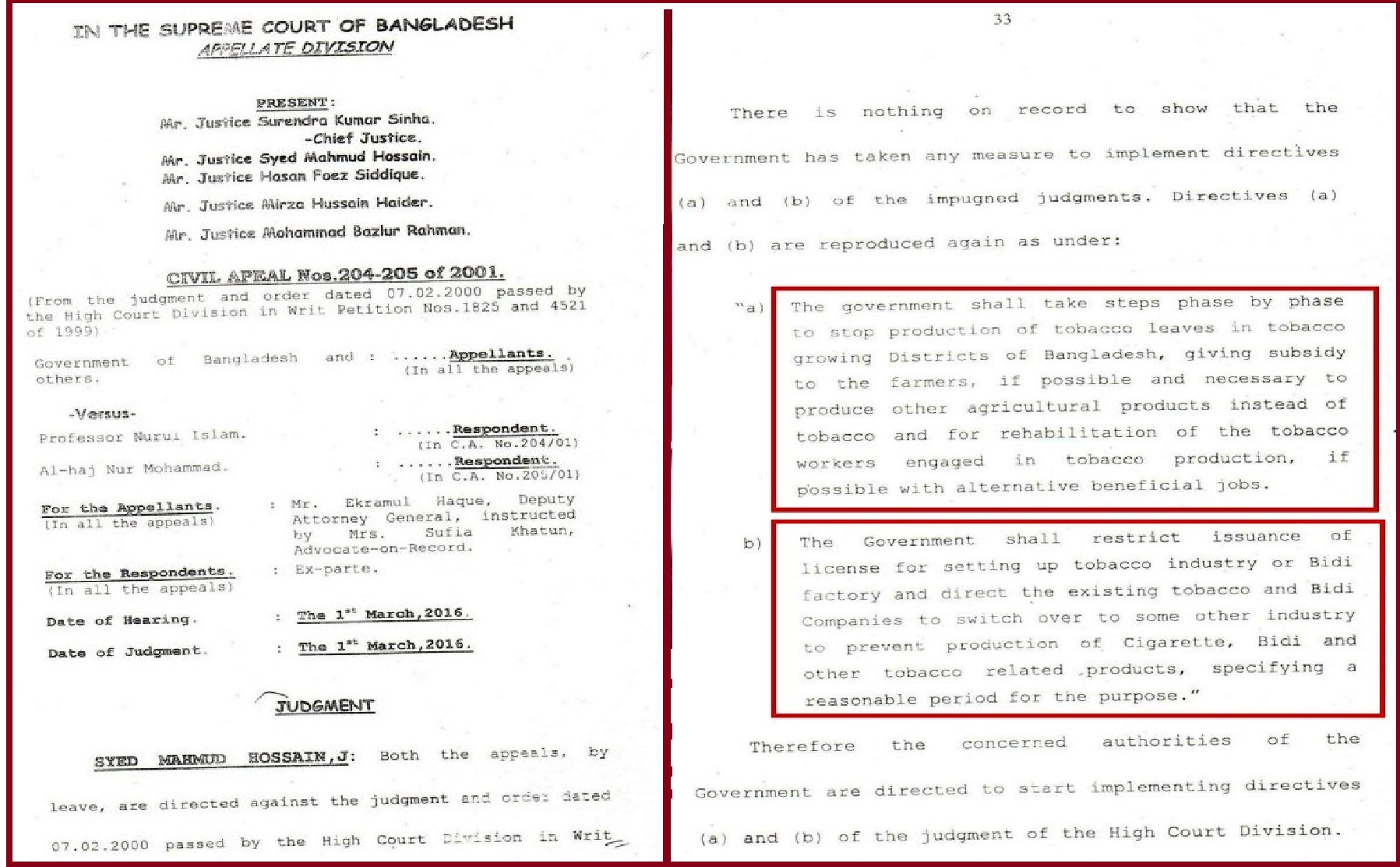
Second: In addition to Cigarettes, handmade cigarettes Bidi Smokeless tobacco product like Jarda, Gul, Emerging tobacco product like e-cigarettes-vapes, the new tobacco product nicotine pouch has been brought under the definition of “tobacco products.” Disregarding public health and public interest due to tobacco company interference, the Bangladesh Investment Development Authority (BIDA) has recently issued clearance for a nicotine pouch factory. This is despite a 1 March 2016 Appellate Division full-bench High Court verdict directing that no approval be given for new tobacco product manufacturing factories. Even after this directive, Japan Tobacco was allowed to operate in Bangladesh in 2018, and currently BIDA and BEZA have granted clearance to Philip Morris to establish a nicotine pouch factory-despite the Ministry of Health formally objecting and requesting cancellation of the approval. 4
Bangladesh already ranks eighth globally in cigarette production and twelfth in tobacco cultivation. Establishing nicotine pouch factories is feared to further increase addiction among youth. 5
The small tablet-shaped but highly addictive drug “Yaba” spread rapidly across the country. With millions of young people addicted, Yaba has become the most prevalent drug in Bangladesh.6 There is concern that nicotine pouches could prove similarly dangerous. Various sources indicate that Yaba sales in Bangladesh amount to approximately BDT 60 billion annually, while the overall narcotics market exceeds BDT 600 billion. 7 According to government data, Bangladesh had approximately 8 million drug addicts in 2023, rising to 8.3 million in 2025, most of whom are smokers. So, tobacco control is crucial to reduce drug use and safeguard the country’s 170+ million people. 8 Bangladesh is currently enjoying a demographic dividend due to its large youth population. If these young people cannot be protected from cigarettes, nicotine pouches, and other addictive substances, the dream of becoming a developed country by 2045 will fail. All addiction begins with cigarettes-cigarettes act as a gateway drug. Therefore, the risk of youth addiction to nicotine pouches is very real.
Third: The amended ordinance bans the import, marketing, and distribution of all e-cigarettes, electronic nicotine delivery systems (ENDS), and heated tobacco products (HTP).
Fourth: The use of all tobacco products, including smoking, has been banned in all public places and public transport. Designated smoking areas will now require government approval. Additionally, advertising, promotion, and display of tobacco products are prohibited at points of sale and across all media, including the internet.
Cigarette companies are conducting illegal business under the guise of legality:
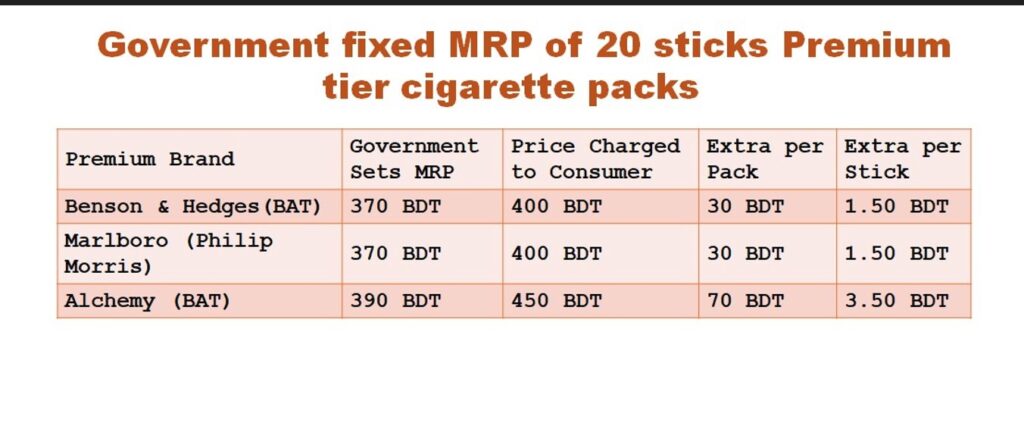
Currently, cigarette companies are violating Maximum Retail Price (MRP) rules through price list advertisements. For example, the National Board of Revenue has set the MRP of a 20-stick Benson packet at BDT 370, making the per-stick price BDT 18.50. Yet cigarette companies force retailers to sell each stick at BDT 20 through widespread advertisements, charging BDT 1.50 more per stick. 9 Consumers pay BDT 400 for a packet priced at BDT 370-an extra BDT 30 per pack. The same practice applies to Marlboro, Gold Leaf, Camel, Lucky Strike, and all other brands. According to NBR data, 654.2 billion sticks were sold in FY 2024-25. By charging one taka extra per stick, companies extracted over BDT 65 billion from consumers, evading around BDT 50 billion in tax revenue at an average tax rate of 81 percent. This malpractice extends across all price tiers.10
Through such tactics, tobacco companies are not only evading taxes but also interfering in policymaking. The year-long delay of the amendment is proof of this.
Although delayed, the interim government deserves thanks for approving the ordinance in the interest of public health and public welfare. However, attempts to conceal information raise serious concern. Past experience shows that implementation rules are often delayed for years after laws are passed. The Press Wing’s silence revives fears that gazette publication and implementation of this ordinance may also be delayed.
Key proposals from tobacco control activists ignored:
Activists proposed banning single-stick cigarette sales and bringing retailers under a licensing system, but the interim government rejected both.11 As discussed earlier, single-stick sales alone allow companies to extract nearly BDT 70 billion annually while evading around BDT 50 billion in tax.
Regarding retailer licensing: if cigarette sellers were licensed, retailers, the National Board of Revenue, and the government would all benefit. Currently, there is no registry of tobacco retailers nationwide. A nominal annual registration fee of BDT 300 could have brought them under regulation.
Three benefits of licensing retailers:
One: Registered retailers would gain official recognition as small businesses and become eligible for government assistance during disasters or unrest-support they previously lacked due to lack of identification.
Two: NBR could use the database to combat illegal foreign cigarette sales by sending SMS alerts to retailers, enhancing accountability. Tobacco companies oppose this because of their documented global links to smuggling. They misled advisers by claiming licensing would ruin small shopkeepers, when in fact it would threaten their own unregulated business.
Three: A BDT 300 annual fee from sellers of cigarettes, bidis, tea, and biscuits would marginally increase local government revenue-less than one taka per day, hardly enough to shut down a business.
Despite these benefits, the interim government missed an opportunity to curb smuggling and illegal sales. If tourists must register to protect St. Martin’s biodiversity, why is retailer registration unreasonable? Mobile SIM cards require national ID registration, so what is the problem with shop registration? The truth is, the problem lies within. Despite claiming concern over revenue loss, cigarette companies do not want smuggling to stop.
It is also worth noting that millions of cases remain pending in courts, many naming hundreds of unidentified accused-putting ordinary shopkeepers at risk of harassment. Registration would have limited this risk. Ignoring these realities, the interim government chose to believe tobacco company scare tactics.12
Still, despite the delay, I sincerely thank the interim government for approving the Smoking and Tobacco Products Control (Amendment) Ordinance and hope it will be published in the gazette soon. Without gazette notification, details of the changes remain unclear. We must remember: public health and public interest must come first.
Author:
Sushanta K. Singha, Journalist & Public Health Analyst
📧 sinhasmp@yahoo.com
