
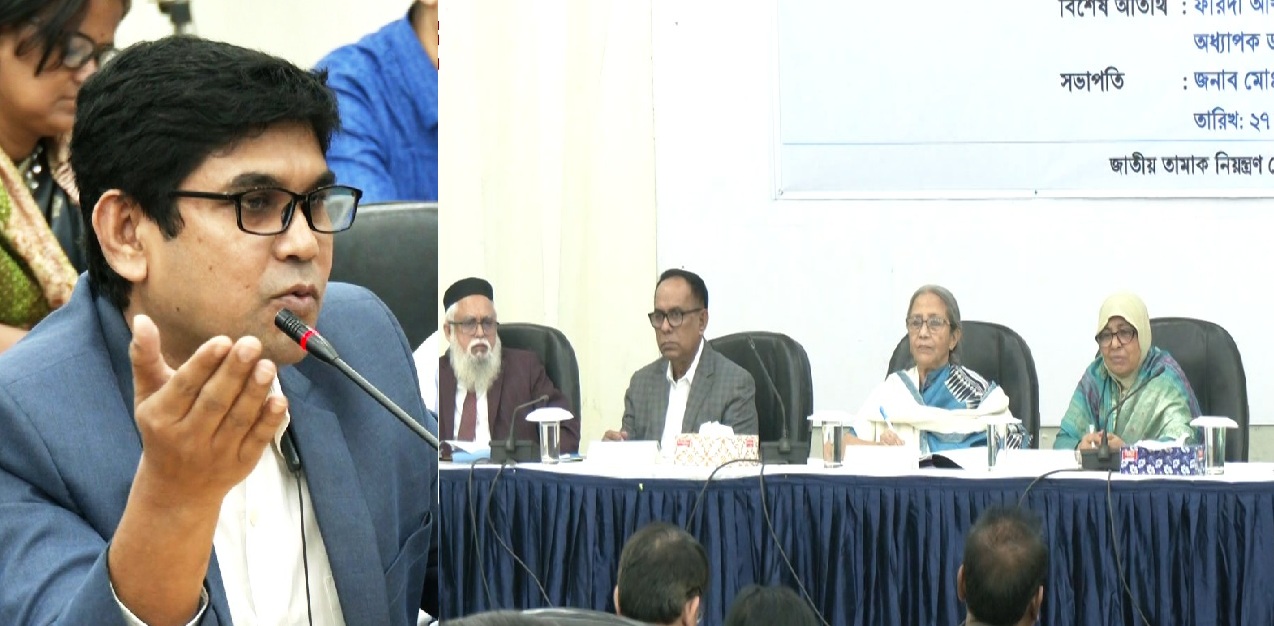
The National Tobacco Control Cell (NTCC) of Bangladesh organized a consultation meeting on the implementation of the Smoking and Tobacco Products Control (Amendment) Ordinance 2025 on 27 January 2026, Dhaka. The meeting was chaired by Mr. Saidur Rahman, Secretary, Ministry of Health and Family Welfare.
The Chief Guest was Ms. Nurjahan Begum, Adviser to the Ministry of Health and Family Welfare, and the Special Guest was Ms. Farida Akhter, Adviser to the Ministry of Fisheries and Livestock. Other distinguished participants included Dr. Jamshed Mohammad Ahmed, WHO Representative to Bangladesh, the Director General of Health Services, an Additional Secretary (Ms. Sheikh Momena Moni), senior government officials, representatives from 40 government ministries, and leaders of civil society organizations working on tobacco control. I was invited to this consultation as a tobacco control researcher and media professional. During the meeting, I highlighted two major structural challenges that could seriously undermine the effective implementation of the amended tobacco control ordinance.
My Statement at the Consultation Meeting
I would like to begin by congratulating and thanking the interim government for approving the Smoking and Tobacco Products Control (Amendment) Ordinance 2025, even though it came later than expected. This is a significant and commendable step toward protecting public health in Bangladesh. However, I raised two critical concerns that threaten the effective implementation of this ordinance.
1. Two Serving Government Secretaries on BAT Bangladesh Board Raise Serious Conflict of Interest Concerns
At present, two serving Secretaries of the Government of Bangladesh—one from the Ministry of Industries and another from the Office of the Chief Adviser—are members of the Board of Directors of British American Tobacco Bangladesh (BATB). This presents a serious conflict of interest.
The Government of Bangladesh holds only 0.64% of BATB shares, in the name of the Honourable President of Bangladesh. According to established government practice, the state may nominate an Additional Secretary– or Joint Secretary–level official to oversee government interests in multinational companies. This is the standard approach used in other corporations, such as Unilever.
There is no legal or ethical justification for appointing serving Secretaries, who hold the highest administrative authority in the state, to the board of a tobacco company. This practice has continued for years in a strategic manner by BAT. Previously, a Principal Secretary from the Prime Minister’s Office served on the BAT board; now a Secretary from the Office of the Chief Adviser has taken that role.
This situation creates an environment in which government officials across ministries feel constrained and discouraged from enforcing tobacco control laws or formulating strong implementing rules. If this conflict of interest is not addressed immediately, it will seriously weaken both the enforcement of the ordinance and the development of its implementing rules.
Bangladesh has already experienced this problem. Although graphic health warnings were mandated by law, their implementation was delayed and diluted due to internal resistance and tobacco industry influence within the legislative and administrative system.
2. Rapid Expansion of Tobacco Cultivation and Industry Control over Pricing
The second major concern is the alarming expansion of tobacco cultivation in Bangladesh. Compared to the 2023–24 season, tobacco cultivation increased by approximately 50,000 acres in 2025, bringing the total area under tobacco cultivation to 142,000 acres. This growth is driven by rising domestic consumption as well as a sharp increase in tobacco exports. At least six major companies in Bangladesh are exporting tobacco to countries including India, Pakistan, Brazil, Singapore, and Germany, largely because tobacco leaf prices in Bangladesh remain extremely low.
As a result, agricultural land is being degraded, environmental damage is increasing, and public health is being compromised—while tobacco companies earn substantial profits from exports.
A key structural problem lies in the tobacco leaf pricing mechanism. Under the Department of Agricultural Marketing, the tobacco leaf price fixation committee includes 14 government officials, along with four representatives from tobacco companies, including British American Tobacco, Dhaka Tobacco, Nasir Tobacco and other major firms.
This means that the buyers themselves are directly involved in setting the price they pay for tobacco leaves. Consequently, tobacco can never be a profitable crop for farmers; it is profitable only for tobacco and cigarette companies. This pricing committee was originally established in 1977 and was amended in 2006 to include representatives from four tobacco companies. This amendment must be repealed as a matter of urgency.
Conclusion
In conclusion, if Bangladesh is serious about implementing the amended tobacco control ordinance, the government must eliminate conflicts of interest and completely remove tobacco industry influence from policy-making and regulatory processes. This is a matter of state responsibility, governance integrity, and political commitment.
