

In the first week of June, on Thursday, the newly elected Bangladesh Nationalist Party (BNP) government, led by Prime Minister Tarique Rahman, is set to present its first national budget. Riding a landslide electoral mandate, the new administration assumes office amid heightened public expectations alongside acute fiscal stress. As public health journalist Sushanta Singha’s analysis underscores, the most immediate and formidable challenge before the government is significantly boosting revenue collection—an essential prerequisite for financing policy commitments, containing deficits, and restoring macroeconomic stability in Bangladesh.
As usual, the National Board of Revenue (NBR) began the preliminary and phased process of preparing the budget for fiscal year 2026-27 as early as February. Centering on the budget, not only the government but also tobacco control activists have become active. At the same time, cigarette companies have also started lobbying policymakers, including the NBR. As a result, from February onward, a wide range of proposals from both domestic and international organizations regarding price increases and tax hikes on cigarettes and other tobacco products have begun to circulate.
Bangladesh’s cigarette tax structure is extremely complex compared to that of most other countries. The situation is further complicated by the fact that the NBR’s revenue collection and monitoring systems are not yet fully technology-driven. This complexity creates significant opportunities for tobacco companies to evade taxes.
In particular, by increasing cigarette prices year after year without raising taxes, policymakers have allowed cigarette companies to generate uninterrupted profits. Proposals that focus solely on price increases without corresponding tax hikes may appear, at first glance, to raise consumer costs. In reality, however, they primarily open the door for enormous profits for tobacco companies. This situation is dangerously self-destructive.
As a tobacco control journalist, there is no scope to support any proposal that leads to increased profits for tobacco companies. Additional profits mean further expansion of the “business of death.” With higher profits, these companies gain greater capacity to exert influence across the government administration and throughout society-posing a grave threat to public health and national interest.
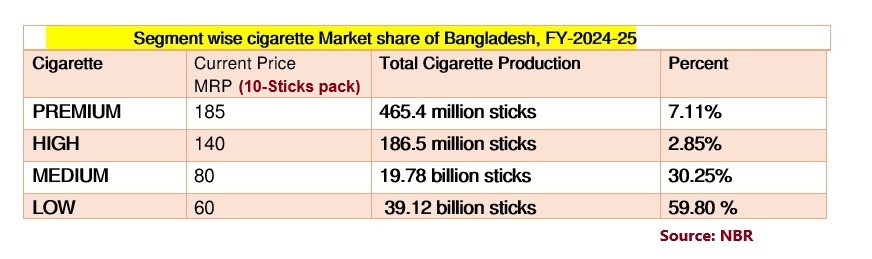
Four-Tier Cigarettes and Their Production in Bangladesh :
To understand Bangladesh’s cigarette tax structure, it is essential first to examine tier-based production, maximum retail prices (MRP), and market share. In Bangladesh, cigarettes are divided into four price tiers: Premium, High, Medium, and Low.
In the premium tier, which includes brands such as Benson and Marlboro, the maximum retail price of a pack of 10 sticks is BDT 185. Total production in this tier stands at 465 million sticks, accounting for 7.11 percent of total cigarette production.
The second-highest priced category is the high tier. This tier, which includes brands such as Gold Leaf, has an MRP of BDT 140 per 10-stick pack. In fiscal year 2024-25, production in this tier amounted to 186 million sticks, representing 2.85 percent of total production.
In recent years, the market share of the medium tier has been increasing rapidly. The MRP for a 10-stick pack in this tier is BDT 80. Total production in this segment reached 19.78 billion sticks, accounting for 30.25 percent of all cigarettes produced.
The largest volume of cigarettes is produced in the low segment. Cigarettes in this tier are among the cheapest in the world. Due to their low price, consumption is high. The MRP for a 10-stick pack is BDT 60. Production in this tier stands at 39.12 billion sticks, representing nearly 60 percent of total cigarette production.
Cigarette Market Share: Multinationals vs Domestic Companies :
In other words, nearly 90 percent of all cigarettes in Bangladesh fall within the low and medium tiers. These two segments are effectively dominated by multinational cigarette companies. According to NBR data, in fiscal year 2024-25, approximately 77 percent of the total cigarette market was controlled by British American Tobacco Bangladesh (BATB). The second-largest market share belongs to Japan Tobacco, with 12.21 percent.
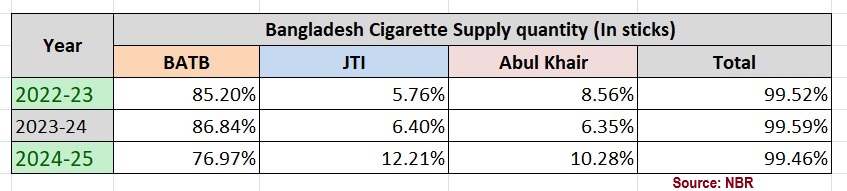
Combined, these two multinational cigarette companies control 89.18 percent of the market. Among domestic companies, the Abul Khair Group ranks highest, with a market share of 10.28 percent. The remaining 0.5 percent is held by other local companies. Dhaka Tobacco, originally known as United Dhaka Tobacco Company Limited, now operates as JT International Bangladesh Limited, a subsidiary of the multinational Japan Tobacco Group. In 2018, Japan Tobacco International acquired Akij Group’s Dhaka Tobacco cigarette business for $1.47 billion. This remains the largest single corporate investment in Bangladesh and is fully integrated into the global operations of the Japan Tobacco Group.
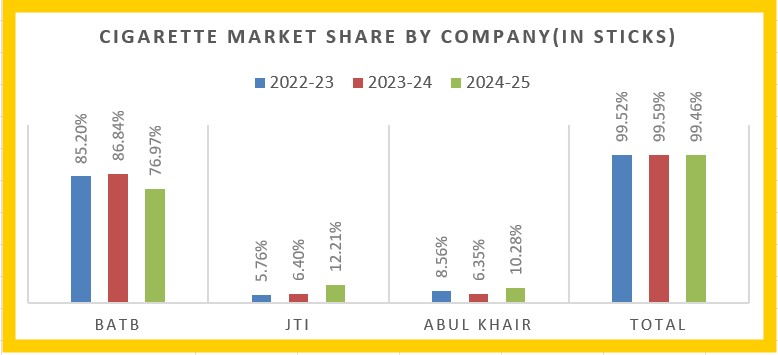
Compared to fiscal year 2023-24, the market share of Japan Tobacco has nearly doubled. Similarly, the market share of the domestic company Abul Khair Group has also almost doubled. However, due to factory relocation, production by British American Tobacco declined slightly, leading to an approximately 10 percent reduction in its market share. As a result, rather than smuggling, it was the production shortfall of BAT that was almost entirely captured by its two rival cigarette companies.
Sushanta k singha, Broadcast Journalist, Ekattor Television, & Public Health Researcher , sinhasmp@yahoo.com
