
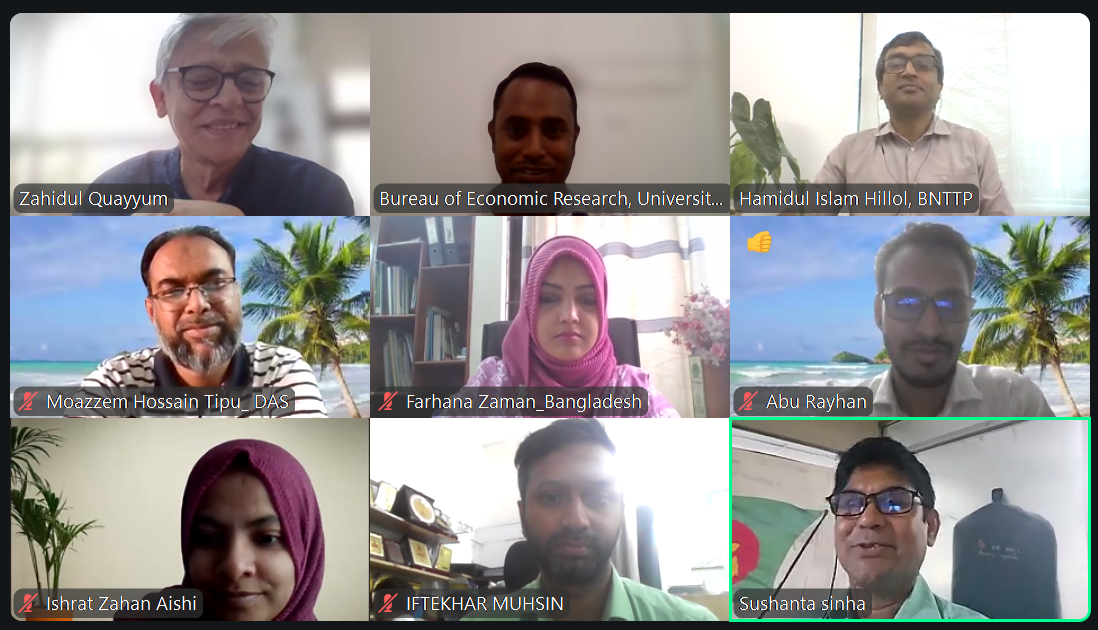
At a webinar titled “Impact of a Strong Tobacco Control Law on the National Economy,” experts called for the rapid conversion of the tobacco control ordinance into a full law in Bangladesh to protect public health and strengthen the national economy. The webinar was organized by the Bangladesh Network for Tobacco Tax Policy (BNTTP) on Zoom on Wednesday, March 11, 2026.
According to recent data from the Tobacco Atlas, around 199,000 people die every year in Bangladesh due to tobacco use, while the country spends approximately BDT 87,000 crore annually on tobacco-related diseases. In contrast, the government earns only about BDT 40,000 crore in revenue from the tobacco sector. Experts emphasized that strengthening the tobacco control law is essential to reduce health risks and economic losses.
Presenting the keynote, Hamidul Islam Hillol, Project Director of BNTTP, stated that government revenue from tobacco has increased 16 times over the past 21 years, and revenue growth continued even after amendments to the tobacco control law in 2005 and 2013. He noted that tobacco companies often spread claims about declining revenue and rising illicit cigarette trade whenever tax increases or stricter regulations are proposed. However, cigarettes are not among the top ten seized illegal products by the National Board of Revenue, and a study by ARC Foundation found that illegal cigarettes account for only about 5.4 percent of the market.
Sushanta K. Singha, Planning Editor of Ekattor Television, said that despite the rising number of tobacco-related deaths, government revenue from the sector remains comparatively low due to weak tobacco control laws and interference from tobacco companies. He accused multinational tobacco companies of spreading misinformation to influence policymakers and urged the government to quickly enact the ordinance into law and adopt a comprehensive tobacco tax policy.
Dr. Golam Mohiuddin Faruk, President of the Bangladesh Cancer Society, highlighted that efforts to amend the tobacco control law have been delayed for years due to interference and propaganda from the tobacco industry. He urged the government to finalize the law swiftly, emphasizing that human lives must be prioritized over business interests.
Professor Zahidul Kaiyum from the BRAC James P Grant School of Public Health stressed the importance of stronger tobacco control measures to protect the younger generation, noting that tobacco companies deliberately target youth in their business strategies. He also warned about the growing harm caused by both direct and secondhand smoking.
The webinar was moderated by Ibrahim Khalil, Senior Project and Communication Officer of BNTTP, and attended by representatives from various organizations working on tobacco control in Bangladesh. Approximately 50 participants from different organizations joined the discussion and actively contributed.
