
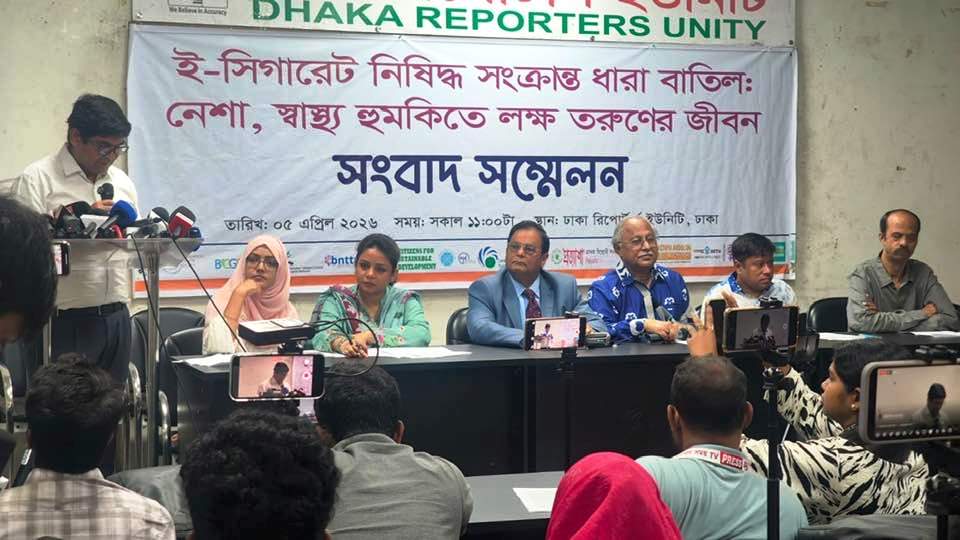
After nearly one and a half years of delay, the outgoing interim government of Bangladesh passed the amendment to the Tobacco Control Act 2005 in the form of an ordinance, in which the use, production, and marketing of all types of e-cigarettes were banned. The ruling BNP government has now taken an initiative to turn the Tobacco Control Ordinance 2025 into a law. However, amid alleged interference from tobacco companies, the government has moved to legalize emerging tobacco products such as e-cigarettes and vapes by repealing two key provisions of the ordinance. At the same time, restrictions on tobacco advertising at points of sale have also been withdrawn. Public health experts warn that these changes could lead to increased use of emerging tobacco products in Bangladesh, posing a serious threat to public health. On April 5, 2026, several organizations working on tobacco control jointly organized a press conference to express their concerns. At the event, I also presented my views as a tobacco control researcher.
The detailed news of the press conference is available here;
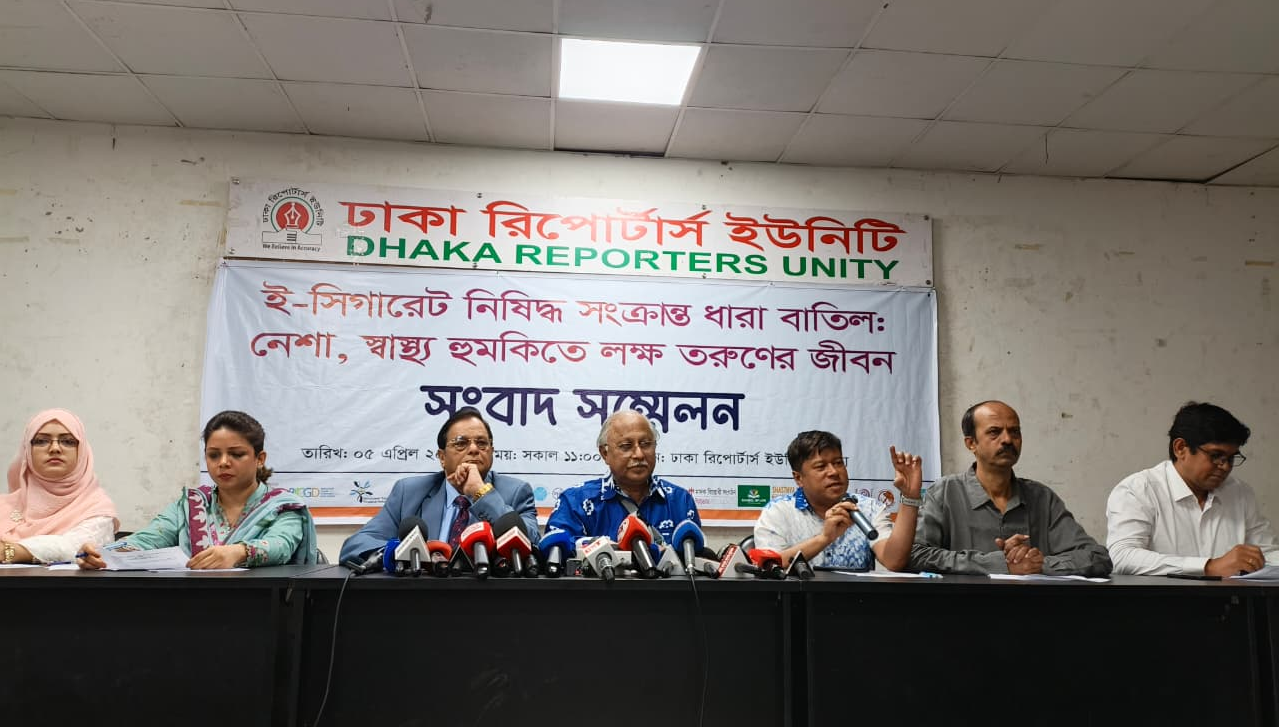
Anti-tobacco activists and public health experts on Sunday warned that legalizing e-cigarettes by repealing a key provision of the Smoking and Tobacco Products Control Ordinance 2025 could put millions of young people at serious health risk.
They said removing the proposed amendment to Section 2(c), which includes provisions to ban e-cigarettes, would increase addiction among youth and expose them to harmful substances. They also expressed concern that e-cigarettes could be used as a medium for consuming other addictive drugs, posing a serious threat to public health. Instances of e-cigarettes being found in school students’ bags were also highlighted.
The warnings came at a press conference titled “Repealing the clause on e-cigarette ban: addiction and health risks threatening millions of youth lives”, jointly organized by 18 anti-tobacco organizations at the Shafiqul Kabir Auditorium of the Dhaka Reporters Unity.
Dr. Golam Mohiuddin Faruk, president of the Bangladesh Cancer Society and a cancer specialist, chaired the event. Among the speakers were Professor Dr. Arup Ratan Chowdhury, founder president of MANAS; Sushanta Singha, planning editor of Ekattor Television and a tobacco control researcher; Aminul Islam Babul, head of programme at CLPA; Barrister Nishat Mahmud, member secretary of the Public Health Lawyers Network; and Md. Bazlur Rahman, associate professor at Dhaka International University. Helal Ahmed, acting coordinator of the anti-tobacco alliance, also spoke at the event.
The keynote was presented by tobacco control expert Farhana Zaman Liza, while the session was moderated by journalist and researcher Ibrahim Khalil.
Dr. Golam Mohiuddin Faruk, president of the Bangladesh Cancer Society, said that chemicals in e-cigarettes could damage reproductive health in both men and women and may lead to birth defects in newborns. He emphasized that banning e-cigarettes is essential to protect public health and questioned why efforts are being made to weaken existing tobacco control laws.
Professor Dr. Arup Ratan Chowdhury, founder president of MANAS, said there is no scientific evidence to support claims that e-cigarettes are less harmful. He said the World Health Organization has identified e-cigarettes as harmful and warned against introducing such products in Bangladesh, where their usage remains minimal. He added that 41 countries have already banned e-cigarettes.
Sushanta Singha, planning editor of Ekattor Television and a tobacco control researcher, said that globally e-cigarettes are considered tobacco products, but there are attempts in Bangladesh to exclude them from that definition. He also expressed concern over efforts to repeal restrictions on tobacco advertising at points of sale, warning that such steps could expose more young people to harmful products.
Aminul Islam Babul, head of programme at CLPA, said the health ministry has not taken a strong enough position to retain the ban. He noted that although only around 0.2 percent of people use e-cigarettes in Bangladesh, there are efforts to legalize the product, which could benefit foreign companies while putting youth at risk.
Barrister Nishat Mahmud, member secretary of the Public Health Lawyers Network, referred to a court directive urging the government to gradually reduce tobacco use and avoid approving new tobacco-related industries. She called for banning retail cigarette stick sales and nicotine pouches and stressed that e-cigarettes must remain prohibited.
Helal Ahmed, acting coordinator of the anti-tobacco alliance, said the use of e-cigarettes is spreading rapidly, particularly among young people, and stressed the need to maintain the ban to protect future generations.
Md. Bazlur Rahman, associate professor at Dhaka International University, said that even under the current ban, controlling e-cigarette use has been difficult, and legalizing it could lead to widespread use on a large scale.
The organizers said that 41 countries have already banned e-cigarettes and urged the government to maintain the existing prohibition to safeguard public health and protect youth.
The organizations that arranged the press conference included Bangladesh Anti-Tobacco Alliance (BATA), Bangladesh Tobacco Control Advocates (BTCA), Bangladesh Network for Tobacco Tax Policy (BNTTP), Bangladesh Tobacco Control Research Network (BTCRN), Bangladesh Center for Governance and Development (BCGD), Bangladesh Cancer Society, ARTH Foundation, Leaders in Tobacco Control Alumni Association, LET’S WORK, Prottasha Anti-Drug Organization, Public Health Lawyers Network, Shastho Andolon, SETU, Tobacco-Free Women’s Alliance (TABINAJ), United Forum Against Tobacco, School of Life, Youth for Tobacco-Free Bangladesh, and Citizens for Sustainable Development.
ই-সিগারেট নিষিদ্ধ সংক্রান্ত ধারা বাতিল : নেশা, স্বাস্থ্য হুমকিতে লক্ষ তরুণের জীবন
