
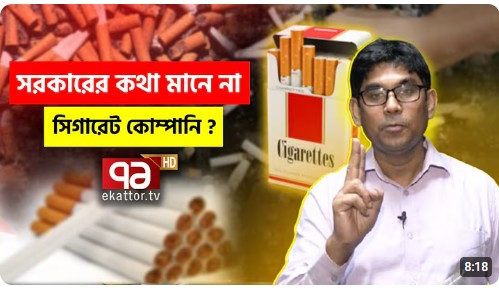
Following the government’s cigarette price revision on 11 June 2026, tobacco companies began promoting prices higher than the government-declared Maximum Retail Price (MRP) through newspaper advertisements and point-of-sale price charts. These practices raise concerns about sales above the approved MRP and potential violations of the Smoking and Tobacco Products Usage (Control) Act, 2005 (amended in 2013), which prohibits direct and indirect tobacco advertising, promotion, and sponsorship. This visual presentation examines these issues and their implications for consumers, government revenue, and regulatory enforcement.
‘In Bangladesh, cigarette prices are officially determined by the government through the national budget and tax structure as part of its efforts to protect public health and reduce tobacco consumption. The government sets a Maximum Retail Price (MRP) for different cigarette brands, and excise duties, supplementary duties, and VAT are calculated based on this declared MRP. By definition, the MRP represents the highest price a consumer should be required to pay for a product.
However, the reality in the marketplace raises serious questions about whether the government’s pricing policy is being effectively enforced.
For example, the government has fixed the Maximum Retail Price (MRP) of a 20-stick pack of Benson cigarettes at Tk 420, meaning each cigarette should cost Tk 21 when sold individually. Yet tobacco companies have distributed price charts and stickers to retailers instructing them to charge Tk 23 per stick. As a result, consumers are being asked to pay more than the government-approved MRP.
This raises a fundamental question: if the government determines the Maximum Retail Price, how can tobacco companies instruct retailers to charge more than that amount?
Such a practice has two serious consequences. First, consumers are being charged more than the legally declared MRP. Second, the additional amount collected above the MRP falls outside the tax structure on which government revenue is calculated. Consumers pay more, but the government receives no corresponding increase in revenue.
The issue extends beyond pricing. Bangladesh’s tobacco control laws prohibit direct and indirect advertising of tobacco products. Nevertheless, tobacco companies continue to publish cigarette price lists in newspapers and distribute branded pricing materials to retail outlets. These price announcements serve not only to communicate prices but also to reinforce brand visibility and market presence, raising questions about compliance with tobacco advertising restrictions.
Another concern relates to retailer margins. In most consumer goods markets, manufacturers provide retailers with a reasonable profit margin within the declared MRP. In the cigarette market, however, retailers frequently receive extremely limited margins. Consequently, they are encouraged directly or indirectly to recover their profits by charging consumers more than the government-declared MRP. Company-issued price charts displaying prices above the approved MRP further institutionalize this practice.
The problem is not new. Following annual budget announcements, cigarette packets bearing old printed MRPs often remain in circulation for months while being sold at higher prices. Consumers routinely encounter situations where the price printed on the packet differs from the price being charged at the point of sale.
Given the scale of cigarette consumption in Bangladesh, even an additional Tk 1 or Tk 2 per cigarette sticks translates into billions of taka collected from consumers every year. This raises significant concerns regarding consumer rights, market regulation, tax compliance, and the rule of law.
The question is simple: if the government declares a Maximum Retail Price, should any company be allowed to establish a higher effective retail price through stickers, price charts, or retailer instructions?
The Directorate of National Consumer Rights Protection, the National Board of Revenue (NBR), the Ministry of Commerce, and other relevant regulatory authorities should urgently investigate these practices. If cigarettes are being sold above the government-declared Maximum Retail Price and pricing materials are being used as a form of indirect tobacco advertising, immediate regulatory action is necessary to protect consumers, safeguard government revenue, and uphold the law.’
stroy link….
