
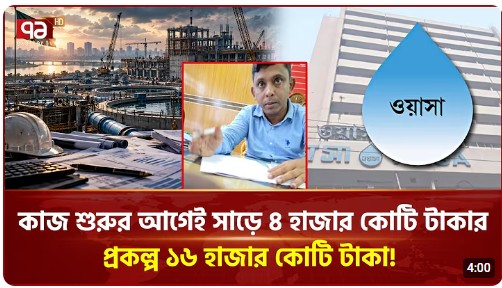
Saidabad Phase III Water Project Cost Quadruples Before Main Work Begins
The cost of Dhaka WASA’s Saidabad Phase III water project has quadrupled in two phases before the main construction work has even begun. A project initially estimated at around Tk 40 billion now stands at nearly Tk 160 billion. Analysts call the increase abnormal and inconsistent.
The project aims to bring water from the Meghna River to the Saidabad Water Treatment Plant for purification. About 70 percent of its cost is financed by foreign loans. It was originally due for completion in 2020, but main construction did not start until March 2026.
Pumping station planned on Meghna River: Under the project, Dhaka WASA will build a pumping station at Haria in Baidyer Bazar, Sonargaon Upazila, Narayanganj. It will carry 950 million litres of Meghna water daily to the Saidabad plant.
The project was initiated in 2015 during the tenure of Taksim A. Khan, with a budget of around Tk 40 billion and a 2020 deadline. It was left unfinished, and in 2021 its duration was extended to 2025 while the budget rose to roughly Tk 75 billion.
After the interim government took office, Asif Mahmud Shojib Bhuyain took charge of the Local Government Division as adviser. At the ECNEC meeting on March 23, 2025, the cost was raised again to Tk 160 billion, although only about 2 percent of the work had been completed.
“Where is the explanation?”: Mohammad Touhidul Islam, Director of Transparency International Bangladesh (TIB), said: “Ten years have passed. Even if I account for cost inflation, the cost should double. But why has it increased fourfold? What is the explanation for that? This lack of transparency is precisely where collusion, corruption, and ultimately the embezzlement of funds occur.”
Even after the budget increase, construction of the pumping station on the Meghna’s bank did not begin until March 2026. So far, only the sand-filling work along the river has been completed.
Alleged nexus: Economist Dr. Khondaker Golam Moazzem, president of the Knowledge Hub Institute, said: “Those involved in the government’s project approval process, the individuals appointed as project directors, and the contractors implementing these projects are developing a kind of nexus among themselves. All three parties want projects to be delayed or deferred by any means possible, rather than completed on time.”
Foreign loans and their responsibility: Development agencies from France and Germany, along with European banks, are providing about Tk 110 billion in loans, roughly 70 percent of the total cost. No new components have been added to the project, which is why analysts consider the fourfold rise abnormal.
Touhidul Islam of TIB said: “Bangladesh has now, in a sense, become a market for loans. If you can sell loans, if you can simply provide loans, that is enough. The government, or the people of Bangladesh, will have to repay them. Whether the lenders have conducted sufficient due diligence, or whether any due diligence has been carried out at all, is now a matter of serious question.”
The Phase III treatment plant will be built inside the existing Saidabad complex, so no additional land acquisition is needed.
Questions over project director: There are also allegations that the current project director does not meet the qualifications required to manage a mega-project. Project Director Mostafizur Rahman declined to comment when approached.
Comparison with similar project: WASA’s Gandharbpur project, which also involves bringing and treating Meghna water, had an estimated cost of Tk 110 billion even after 67 kilometres of pipeline had been laid. The Saidabad Phase III project, with a 52-kilometre pipeline, has a budget of Tk 160 billion.
The public will pay: WASA could not get Saidabad Phase III started in ten years, yet it raised the cost fourfold. The money for the additional expenditure will come from the same source as ever: “Gouri Sen will pay,” as the Bengali saying goes, meaning someone else foots the bill. In this case, that is the ordinary people of the country. Whoever does the borrowing, it is ultimately the public who must repay the debt.
By Sushanta Singha, Ekattor, Dhaka
