
Sushanta K Singha
For several years, multinational cigarette companies and various individuals and groups associated with them have conducted extensive publicity campaigns in Bangladesh about cigarette smuggling and counterfeit cigarettes. Until 2018, news reports frequently covered the seizure of cigarette consignments and cartons smuggled from abroad at the country’s airports, seaports, and land ports. Such reports appeared particularly frequently in April, May, and June.
In 2018, I conducted a study analyzing news coverage of cigarette smuggling in Bangladesh.1 An analysis of reports published in 20 national newspapers found that the overwhelming majority of these stories appeared between April and June. Bangladesh’s national budget is presented in the first week of June. The timing raised questions about whether cigarette companies were using smuggling-related news coverage to put pressure on the National Board of Revenue (NBR) to prevent increases in cigarette taxes. The argument was that higher taxes would increase cigarette smuggling, causing the NBR and the government to lose substantial revenue. Critics have alleged that BAT Bangladesh used this fear of potential revenue losses to influence tax policy.
From 2019 onwards, reports of cigarette smuggling in Bangladesh began to decline. In their place, reports emerged about alleged counterfeit cigarette manufacturing facilities being discovered in different parts of the country. In effect, stories about smuggling were increasingly replaced by reports about alleged domestic production of counterfeit cigarettes.
More recently, news coverage of alleged counterfeit cigarette factories has increased further. However, a review of many such reports reveals a lack of specific information. Details about the locations of the alleged factories, their production processes, the individuals or companies involved, and the products seized are often not disclosed. In some cases, reports following enforcement raids show only a few discarded Benson or Gold Leaf cigarette packets.
There have also been allegations that BAT Bangladesh officials participated in enforcement operations conducted by government agencies, including the Directorate of National Consumer Rights Protection. Critics have questioned whether BAT played a role in such operations to put domestic cigarette manufacturers and competing businesses under commercial pressure.
BAT Officials Present During Enforcement Raids?
Recently, authorities conducted a raid at the Beauty cigarette factory in Manikganj, a district near Dhaka. According to allegations, a BAT Bangladesh official participated in the operation, initially identifying himself as an NBR official. When factory personnel became suspicious and questioned him, he allegedly claimed to be an officer of the Detective Branch (DB) of police. After reportedly changing his identity more than once, the individual left the scene in a vehicle when local residents gathered.
The vehicle’s registration number Dhaka Metro Gha-12-6314 was subsequently checked, and it was reportedly found to be registered in BAT Bangladesh’s name. Officials of Beauty Tobacco alleged that the operation against their factory had been orchestrated at BAT Bangladesh’s instigation. These allegations require independent verification and a response from the parties concerned.2
Are Reports of Cigarette Smuggling and Counterfeiting Being Exaggerated?
As with other products, some foreign cigarette brands are sold illegally in Bangladesh. Several domestic companies have also faced allegations of using counterfeit or imitation brand packaging. However, critics argue that the scale of the problem is not as significant as some campaigns suggest. There are allegations that BAT Bangladesh has amplified a limited number of incidents to create the impression that cigarette smuggling and counterfeiting are widespread in the country. Critics further allege that this narrative is used to gain leverage in policy discussions and commercial negotiations with the National Board of Revenue.
Bangladeshi tobacco-control advocates have long argued that the scale of cigarette smuggling is sometimes portrayed as considerably larger than its actual extent. BAT Bangladesh has also faced allegations of promoting campaigns around relatively obscure or little-known cigarette brands. At the same time, despite speaking out against smuggling and counterfeit cigarettes in its communications with the NBR and the media, the multinational company has allegedly opposed initiatives to register small retailers selling cigarettes.
A comprehensive retailer registration system could help authorities identify sellers distributing counterfeit or illegal cigarettes, whether domestic or foreign, and take appropriate action. This raises questions about how committed BAT Bangladesh really is to eliminating cigarette smuggling and illicit cigarette sales.
The issue is not confined to Bangladesh. British American Tobacco (BAT) has also faced allegations internationally concerning its strategic involvement in cigarette smuggling and illicit trade.
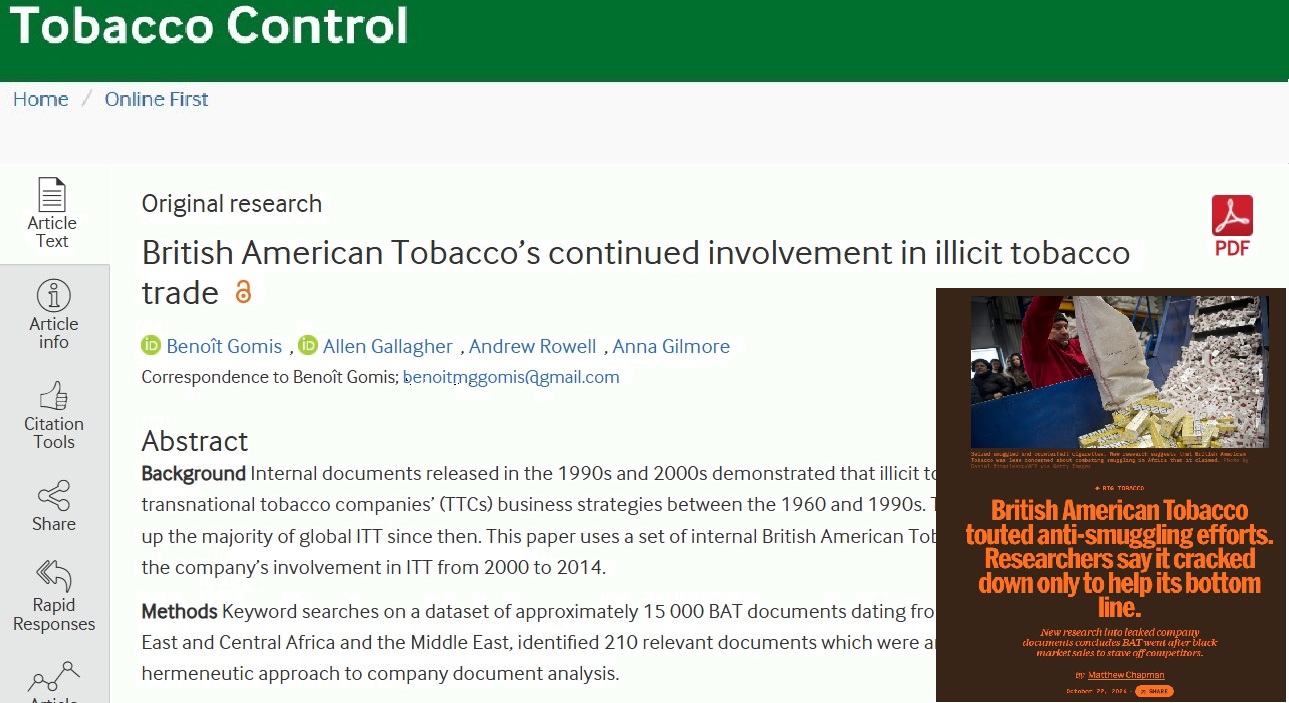
Recently, researchers Benoît Gomis and Dr Allen Gallagher of the Tobacco Control Research Group (TCRG) at the University of Bath in the United Kingdom conducted two studies analyzing approximately 15,000 leaked internal BAT documents. The documents, covering the period from 2000 to 2014, were provided to the researchers by a former BAT employee.
On 22 October 2026, international news outlet The Examination published a special report by Matthew Chapman examining the findings and featuring interviews with the two researchers.
What Did The Examination Report Reveal?
According to The Examination, British American Tobacco has long presented itself as a partner of governments in the fight against illicit tobacco trade and cigarette smuggling. However, the internal documents analyses by University of Bath researchers have raised serious questions about that public position.3
The researchers argue that the documents suggest BAT was not always interested in preventing its own cigarettes from entering illicit markets. In some cases, they found evidence suggesting that anti-smuggling activities were used to gain commercial advantages, capture market share from competitors, and influence policymakers.
The report highlights the apparent contradiction between BAT’s public claims and its internal activities. It also raises a broader question: are tobacco companies’ anti-smuggling initiatives genuinely intended to protect public health and combat illicit trade, or are they strategies to protect their commercial interests and corporate image?
What Did the Research Find?
Researchers at the University of Bath’s Tobacco Control Research Group received approximately 15,000 internal BAT documents from a former employee in 2013 and 2014. The former employee had reportedly worked in the company’s anti-illicit trade division in the Horn of Africa region from approximately 2000 to 2014. By analysing dozens of these documents, the researchers reconstructed aspects of BAT’s internal approach to combating illicit trade.
In their two published studies, Benoît Gomis and Allen Gallagher reported findings suggesting that BAT officials were sometimes reluctant to act even when their own cigarettes were found in illicit markets. The documents also provided examples of anti-smuggling operations allegedly being used to secure commercial advantages. According to the researchers, among the objectives behind these activities were increasing sales of BAT cigarettes, creating opportunities in markets occupied by competitors, and establishing channels of communication and influence with policymakers.
When The Examination sought comment, BAT did not respond. However, the company had previously strongly rejected allegations that its anti-illicit trade activities were being misrepresented. BAT has stated that responsibility and integrity are fundamental to its corporate culture and values. The researchers said they found internal BAT memoranda referring to the goal of creating “Contestable Space” through anti-illicit trade activities. According to BAT’s own terminology, this refers to the maximum theoretical business opportunity available within a particular market segment.
Benoît Gomis explained that by taking action against competitors and working with authorities, BAT could create a gap in the market. The company could then potentially fill that gap by supplying its own legitimate products.
An internal BAT document from Ethiopia in 2013 reportedly indicated that the company was not interested in reducing the flow of its own cigarettes into illicit markets because it lacked the capacity to supply enough legitimate products to fill the resulting gap.
The document reportedly warned that an anti-illicit trade operation could create a market opportunity that would be exploited either by Philip Morris International, a competing tobacco company, or by illicit traders. The researchers also highlighted BAT’s settlement of more than US$629 million in 2023 following a US investigation into violations of sanctions against North Korea.
In 2007, BAT had publicly stated that it had stopped doing business in North Korea. However, the US investigation uncovered a scheme through which cigarettes continued to be supplied to the country for at least a decade. The operation reportedly involved BAT’s Singapore-based affiliate and its longstanding distributor, Singapura United Trading Limited.
The name of this company also appeared in the internal documents obtained by the researchers. The documents reportedly indicated that some cigarettes distributed by a company responsible for BAT’s duty-free cigarette distribution in Mongolia were diverted illegally to the United Arab Emirates and Iraq. Despite these developments, the relevant distributor and commercial relationship were reportedly retained.
The research also alleged that BAT used security companies as intermediaries or “buffers.” According to the researchers, these companies were used to investigate competitors’ alleged involvement in illicit trade, target competing businesses, and seek to mobilise law enforcement agencies against them. The researchers also reported finding evidence suggesting the use of informants to disrupt competitors’ operations, including attempts to establish sham labour unions at competing companies’ factories.4
Is the Argument About Illicit Trade Used to Oppose Tobacco Control?
According to Benoît Gomis, tobacco companies frequently fund research that portrays the scale of illicit tobacco trade as greater than it actually is. Such research may present high tobacco taxes and strict regulatory measures as causes of increased illicit trade. Tobacco companies can then use these findings to support their positions when lobbying policymakers.
However, the researchers argue that countries with higher tobacco taxes and stricter regulatory systems generally tend to have lower levels of illicit trade. One possible explanation is that these countries have stronger institutional capacity to combat illegal commerce. They have also been able to reduce the consumption of both legal and illegal cigarettes.
Allen Gallagher noted that one of the most frequently used arguments against tobacco-control policies is that such measures will increase illicit trade. The researchers do not deny that illicit trade is a genuine problem. Rather, they argue that combating it requires targeted policies and enforcement measures that operate independently of the tobacco industry’s influence. They caution against allowing tobacco companies or other interested parties to exercise a dominant role in efforts to tackle illicit trade.
How Effective Are Anti-Smuggling Campaigns in Protecting Public Health?
Tobacco companies argue that anti-smuggling operations benefit public health because the easy availability of cheap cigarettes on the black market makes it more difficult for people to quit smoking. However, Allen Gallagher said there was no evidence that tobacco-industry-led anti-illicit trade programmes had been effective in reducing the number of smokers.
According to Benoît Gomis, such programmes are primarily a strategy for reshaping the industry’s public image. They allow tobacco companies to present themselves to governments as partners working in the broader public interest. The researchers concluded that BAT’s anti-illicit trade programmes were not necessarily driven by the goals of protecting public health or eliminating illegal trade. Instead, creating new business opportunities, influencing policymakers, and improving the company’s reputation appeared to be among their objectives.
Bangladesh: A Similar Pattern?
In recent years, reports about alleged counterfeit cigarette factories in Bangladesh have circulated across various Facebook pages and websites. Some of these reports have claimed that counterfeit cigarettes are costing the government billions of taka in lost revenue. However, allegations have emerged concerning BAT Bangladesh’s possible role in promoting narratives about counterfeit cigarettes and the associated claims of revenue losses. These allegations require further independent investigation.
The findings of the University of Bath researchers raise important questions about the relationship between tobacco companies’ anti-smuggling campaigns and their commercial interests. In Bangladesh, too, the claims surrounding cigarette smuggling, counterfeit products, and potential revenue losses warrant careful scrutiny. Are these campaigns based on verified evidence of illicit trade, or are they also being used to influence the NBR and secure advantages in policymaking?
The research once again highlights why anti-smuggling initiatives led or supported by tobacco companies should be examined independently, with particular attention to the evidence behind their claims, their commercial interests, and their influence on public policy.
sinhasmp@yahoo.com
Source:
