

Increasing taxes is the most effective way to control the use of cigarettes and other tobacco products to protect public health. Among tax measures, the most effective is imposing a specific tax, because under an ad valorem tax system, producers can earn excessive profits. In Bangladesh, for many years, cigarette companies have flourished due to price increases under the ad valorem system.
Weakness of the Ad Valorem Tax System :
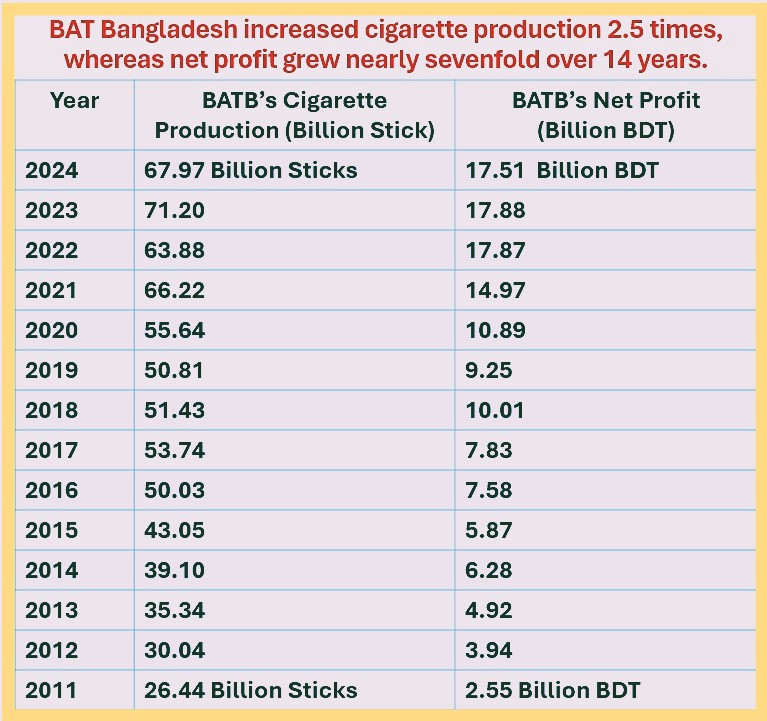
In Bangladesh, the cigarette market is dominated (75%) by the multinational company British American Tobacco (BAT). For example, BAT Bangladesh’s net profit increased nearly sevenfold over 14 years. Between 2011 and 2024, cigarette production increased 2.5 times. According to BAT Bangladesh’s financial report, in 2011, the company produced 26.44 billion sticks with a net profit of 2.55 billion BDT. By 2024, production rose to 67.97 billion sticks and net profit to 17.51 billion BDT. The main reason for such a profit increase, despite only a 2.5-fold rise in production, is the weakness of the existing ad valorem tax system. Not only BAT, but companies like Japan Tobacco and local cigarette producers have also profited similarly.
Mexico’s Landmark Change in the Cigarette Tax Structure
Mexico has taken a historic step to reduce the consumption of high-risk products such as cigarettes and sugary drinks, while strengthening public funding to cover health costs caused by their use. From January 1, 2026, the Mexican government implemented a significant increase in specific taxes on cigarettes and sugary beverages.
Under this reform, tobacco product taxes will increase significantly. The ad valorem rate of IEPS (Excise Tax on Tobacco Products) has been raised from 160% of the retail price to 200%. Consequently, the tax component in the final price will increase substantially. According to the new retail price list, the price per pack will rise by 15 -22 pesos depending on the brand and number of cigarettes per pack, which in Bangladeshi Taka translates to approximately 100 -150 BDT (1 MXN = 6.8 BDT).
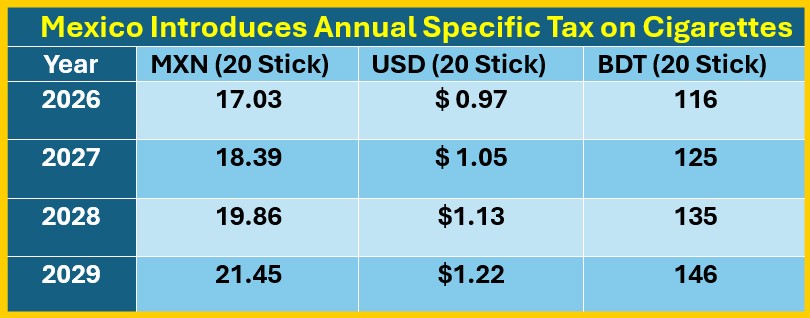
For hand-rolled cigarettes and other handmade tobacco products, the tax rate has increased from 30.4% to 32%. Additionally, a specific tax of 0.8516 MXN per cigarette will be imposed, gradually increasing over time. For a 20-stick pack, the specific IEPS alone will increase by about 17 pesos in 2026, rising to more than 21 pesos by 2029, equivalent to approximately 116–146 BDT in Bangladesh, significantly affecting retail prices.
How much will the price of a 20-stick pack of premium brand cigarettes increase:
In Mexico, the current price of a 20-stick pack of Marlboro cigarettes is 82 Mexican pesos (MXN). Due to the tax increase, from 1 January 2026 this price will rise to 105 MXN. In other currencies, the price will increase from USD 4.7 (BDT 558) to approximately USD 6.0–6.2 (BDT 700-720).
Marlboro: Currently, the price of a 20-stick pack is 82 MXN, which after the tax increase will become 105 MXN. In other currencies, the current price of USD 4.7 (BDT 558) will increase to around USD 6.0 (BDT 710).
Lucky Strike: The current price of a 20-stick pack is 80 MXN, which will increase to 103 MXN after the tax hike. In other currencies, the price of Lucky Strike will rise from USD 4.6 (BDT 544) to about USD 6.0 (BDT 700).
Benson & Hedges: The current price of a 20-stick pack is 85 MXN, which will increase to 106 MXN after the tax increase. In other currencies, a cigarette pack that currently costs USD 5.0 (BDT 578) will need to be purchased at around USD 6.2 (BDT 720).
Pall Mall: The current price of a 20-stick pack is 80 MXN, which after the tax increase will become 96 MXN. In other currencies, the current price of USD 4.6 (BDT 544) will increase to approximately USD 5.6 (BDT 653).
All other nicotine products, excluding imported or locally sold cigarettes, will also be taxed at 200%, with specific tax calculated according to nicotine content.
Overall, this increase in specific taxes will raise the prices of premium brands by 20–30%, directly impacting consumer expenditure. The 2026 tax reform will significantly raise premium cigarette prices in Mexico, reducing consumption while generating revenue that can help cover healthcare costs related to tobacco-related illnesses. Mexican authorities emphasized that this tax increase is not only for revenue but also to reduce the economic burden of tobacco, a globally recognized effective measure for reducing consumption.
Specific Tax of One taka per Cigarette is Urgent for Bangladesh:
Mexico’s phased increase in specific taxes provides a global example. Bangladesh could follow a similar approach. By imposing a specific tax of One BDT per cigarette in the upcoming budget, the Bangladesh government could earn approximately 70 billion BDT extra from BAT alone, and over 80 billion BDT including other cigarette companies. Every cigarette stick produced would directly contribute to government revenue, with no extra profit for companies. This would increase cigarette prices by 1 BDT per stick, reduce consumption, and increase government revenue, while preventing tobacco companies from making extra profits.
Tax Increase on Sugary Beverages:
Mexico also significantly increased taxes on sugary drinks in 2026. The IEPS on sugar-sweetened beverages was raised from 1.64 MXN to 3.08 MXN per liter. A new tax of 1.5 MXN per liter was imposed on drinks containing non-caloric sweeteners.
Example prices:
The price increases will affect both sugar-sweetened and sweetened beverages, influencing daily consumer spending. In Bangladesh, sugary drinks are widely sold at very low prices, increasing consumption among children. However, the government collects minimal revenue due to low taxes and weak monitoring, while children’s obesity and health risks rise. Like Mexico, Bangladesh needs to increase taxes on sugary drinks to protect public health.
Conclusion
Mexico’s 2026 health-oriented tax policy prioritizes public health by increasing taxes on tobacco and sugary beverages. Gradual specific tax increases on cigarettes, their effect on retail prices, and regulation of industrial impacts aim to change consumer behavior. This policy not only generates revenue but also reduces non-communicable disease (NCD) risks and strengthens health systems. In Bangladesh, the incidence of cancer, heart disease, and diabetes is rising rapidly, with NCDs accounting for approximately 70% of total deaths. The primary causes include bidi, cigarette, and other tobacco use, uncontrolled sugary drink consumption, and unhealthy diets. Like Mexico, Bangladesh urgently needs to implement specific taxes on cigarettes, tobacco products, and sugary beverages to protect public health.
Sushanta k Singha, Special Correspondent, Ekattor Television & Public Health Analyst, sinhasmp@yahoo.com
Source news: https://mexicobusiness.news/health/news/mexico-raises-health-taxes-sugary-drinks-tobacco-2026
