

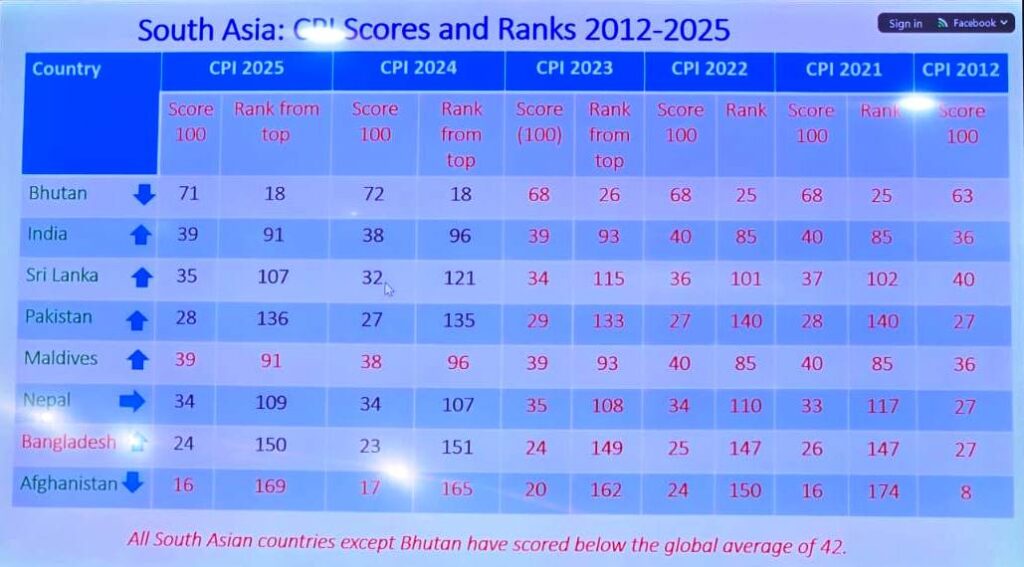
Corruption has increased both globally and in Bangladesh over the past year, according to the Corruption Perceptions Index (CPI) 2025 released by Transparency International Bangladesh (TIB). The report ranks Bangladesh 13th among the world’s most corrupt countries, down from 14th last year, underscoring a continued deterioration in governance and institutional integrity.
The CPI, which assesses corruption in the public sector across 182 countries, shows that corruption remains a persistent global challenge, with many nations making little or no progress. Bangladesh continues to be categorized as a severely corruption-affected country, remaining near the bottom of the global rankings.
Bangladesh Among Worst in Asia-Pacific:
Within the Asia-Pacific region, comprising 37 countries, Bangladesh ranks second from the bottom, performing better than only Afghanistan. TIB noted that despite repeated political commitments to curb corruption, meaningful structural reforms have yet to materialize. Presenting the report at a press conference in Dhaka, TIB stated that the interim government has failed to establish good governance and transparency, reflecting a pattern seen under successive political administrations.
Global Leaders and Laggards:
According to the CPI 2025 findings, Denmark remains the least corrupt country in the world, followed by Finland and Singapore, all of which demonstrate strong institutions, effective rule of law, and high levels of public-sector transparency. At the other end of the index, countries affected by conflict, weak governance, and authoritarian practices continue to dominate the list of the most corrupt nations, with Afghanistan once again ranking at the bottom.
The global data indicates that corruption is significantly higher in countries where democratic accountability is weak and public institutions lack independence.
Concerns Over Governance and Political Capture:
TIB Executive Director Dr. Iftekharuzzaman expressed deep concern over Bangladesh’s governance trajectory. He said that following the after the change in government on August 5, 2024 there has been a renewed surge in political capture and partisan control of state institutions.
He noted that prisonization has spread both inside and outside the Secretariat, the core of the country’s bureaucracy. Instead of strengthening accountability over the past one and a half years, the interim government has allegedly used state institutions to advance personal and group interests, further eroding public trust. TIB also raised serious questions over the lack of transparency in contracts signed hastily and secretly toward the end of the government’s tenure, warning that such practices reinforce entrenched corruption.
Media and Professional Groups Affected:
The organization observed that partisan influence has expanded across professional sectors, including the media, weakening independent oversight and democratic discourse.TIB expressed hope that the next elected government will take concrete measures to fulfill its pre-election pledges to reduce corruption, particularly in the lead-up to national elections.
Without decisive reforms, TIB warned, Bangladesh risks remaining trapped in a cycle of systemic corruption, undermining governance, economic stability, and public confidence.
