
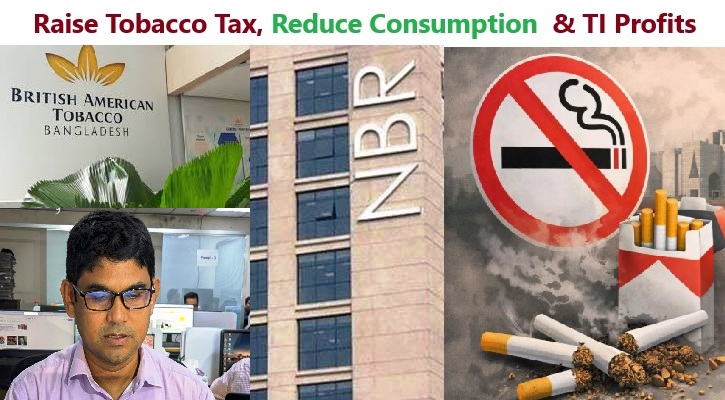
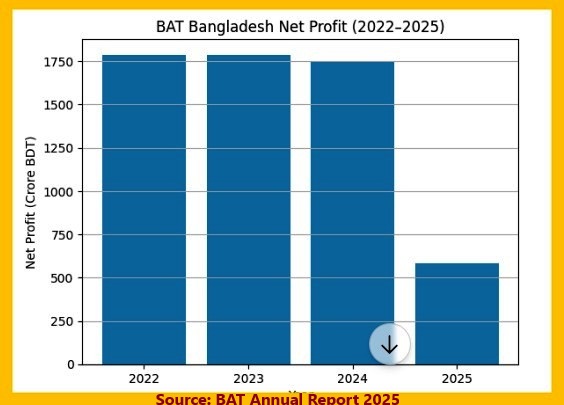
Within a single year, the net profit of cigarette company BAT Bangladesh declined by 67 percent, amounting to a decrease of approximately BDT 11.67 billion. In 2025, its after-tax net profit stood at BDT 5.84 billion. This serves as a notable example of how increased taxation for public health protection can impact economic outcomes, as reflected in the company’s latest financial report.
Current and the past two financial years, supplementary duty on low-tier cigarettes was increased by 9 percentage points in two phases, bringing the total tax burden to 83 percent. Similarly, tax rates on premium, high, and medium tiers were also gradually increased to 83 percent. From the fiscal year 2024–25, a uniform supplementary duty of 67 percent has been applied across all cigarette tiers, which, along with 15 percent VAT and a 1 percent health development surcharge, results in a total tax burden of 83 percent. Aligning tax rates across all four cigarette tiers had long been a demand of tobacco control advocates in Bangladesh.
