

Regarding the cigarette tax structure, the proposal to merge the low and medium tiers, and the kinds of measures that could be included in the upcoming budget, Deshkal News recently published my views alongside those of others. Here, I am further elaborating on the issue and presenting my detailed views. Regarding the proposal to merge the low-tier and medium-tier cigarette categories into a single tier in Bangladesh, tobacco control researcher and Planning Editor of Ekattor Television, Sushanta Singha, told Deshkal News:
“At this moment, there is no need to merge the low-tier and medium-tier cigarette markets in Bangladesh. Doing so right now would backfire on us. Let all four tiers remain, but impose a one-taka tax per cigarette stick. A one-taka specific tax should be added alongside the existing ad valorem system. This would ensure that the revenue goes directly to the government, while the resulting price increase would impact consumers,” added the tobacco control researcher.
“If a specific tax of one taka per cigarette stick is imposed in the upcoming budget, government revenue earnings could increase from Tk 70 billion to Tk 100 billion. On the other hand, if the price of cigarettes across all tiers increases by one taka per stick, it would represent a major jump. Because if the price rises by one taka per stick, then a 20-stick pack would become Tk 20 more expensive, while a 10-stick pack would increase by Tk 10.
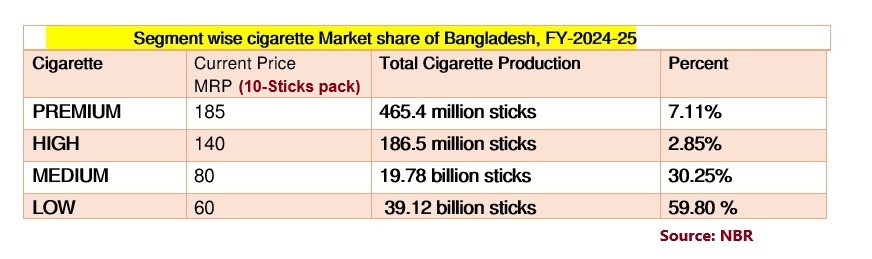
Why am I suggesting one taka per stick? Because in our country there are 10-stick packs, 20-stick packs, and even 12-stick packs. The vast majority of cigarette sales take place through the retail sale of individual sticks. If this system is introduced, there will be no difficulty in counting or calculating. Since companies already submit stick-based figures to the National Board of Revenue (NBR), the NBR will be able to collect taxes accordingly. If 70 billion cigarette sticks are produced, the government will receive Tk 70 billion. If production rises to 75 billion sticks, the government will receive Tk 75 billion. In other words, the government’s revenue will depend directly on cigarette production.
At the same time, the one-taka increase in price through taxation will create pressure on consumers, which will reduce cigarette consumption to some extent.”
Sushanta Singha said:
“Although the Maximum Retail Price (MRP) is enforced for all products in Bangladesh, cigarette companies are the only ones not following the MRP system. For example, the government-fixed MRP of a pack of Benson cigarettes is Tk 370. But cigarette companies are selling it to retailers at Tk 369.98. That means the company is selling the product to retailers for just two paisa less than the MRP. British American Tobacco is supplying cigarettes to retailers at this rate which is complete violation of law.
If a retailer sells a Tk 5 packet of Lexus biscuits, they can buy it at Tk 4 and earn Tk 1 commission. If a bottle of water costs Tk 10, retailers buy it at Tk 8 and make Tk 2 commission. Similarly, for many Tk 10 products, retailers purchase them at Tk 7 or Tk 8 and earn a commission. But for a Tk 370 packet of cigarettes, the retailer gets only two paisa in commission?”
He commented, “Cigarette companies are giving retailers only two paisa in commission. That is why retailers are selling cigarettes at higher prices. Companies even place stickers in shops encouraging higher prices. You will often see in stores that Benson cigarettes are advertised at Tk 20 per stick. When companies put up such stickers, consumers also begin to believe that the price is Tk 20 per stick.
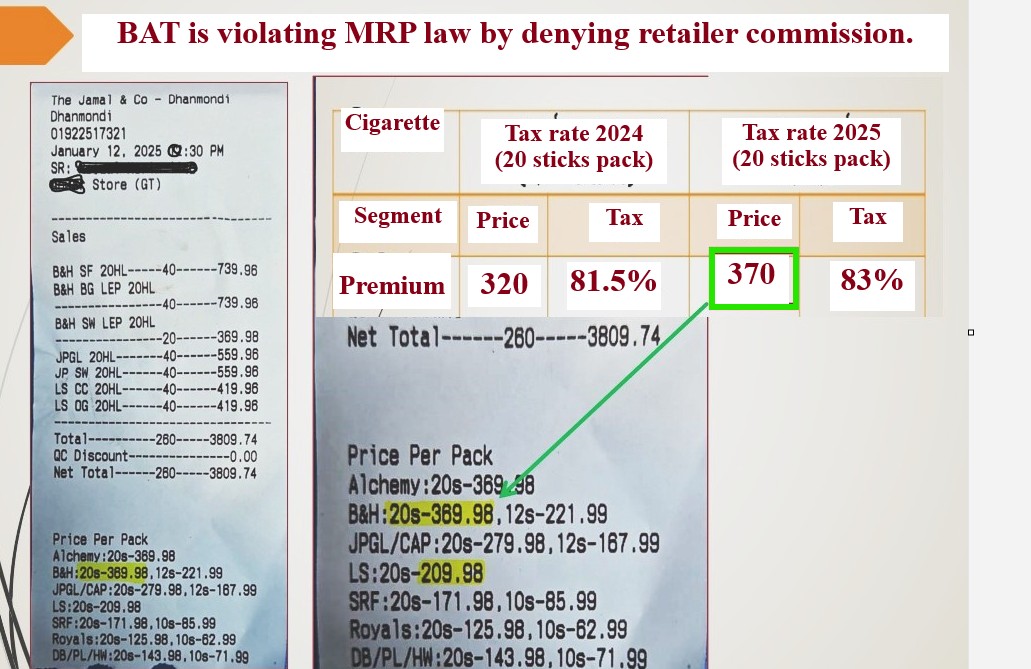
As a result, a 20-stick pack of Benson cigarettes ends up costing Tk 400, whereas the government-fixed MRP is Tk 370. This means cigarette companies are taking an additional Tk 30 per pack from consumers.
No tax is being paid on this extra Tk 30. I have been researching this issue for a long time. On average, an additional one taka per stick is being charged. As a result, consumers in Bangladesh are paying an extra Tk 200 million every day. Tentatively, around 2–2.1 billion cigarette sticks are sold daily in the country. So, if one taka extra is charged per stick, consumers are paying an additional Tk 200 million to Tk 210 million every day.”
So what is the solution? Is it to impose a fixed tax rate on every cigarette?
Sushanta Singha said: “The solution is, first of all, to ensure that cigarettes are sold at the MRP rate. Retailers are collecting extra money from consumers under the influence of cigarette companies. Retailers should be able to purchase a Tk 370 product at Tk 340 or Tk 350 so that they can sell it at the official MRP. This responsibility must be taken by the NBR, the Directorate of Consumer Protection, and the Ministry of Commerce. Because violation of MRP is a major violation, and this does not happen with any other product.”
So the primary wrongdoing lies with the companies? They are charging retailers high prices without giving them profit margins?
Sushanta Singha replied; “Absolutely. They are not giving retailers any profit or commission. In the case of cigarettes, companies are not complying with MRP regulations. My logical demand is that in the upcoming budget, instead of increasing prices directly, prices should rise through higher taxation.
For example, I am proposing a one-taka specific tax per cigarette stick across all tiers—from low-tier to high-tier cigarettes. This should be imposed in addition to the existing ad valorem taxation system.”
So the current ad valorem system would remain, and an extra one taka per cigarette would be added?
Sushanta Singha said:
“Yes, a one-taka specific tax would be added. If such a tax is imposed, two things will happen. A 10-stick pack of cigarettes will become Tk 10 more expensive. This means there will be an impact on consumers. And the entire Tk 10 increase will go directly to the government as revenue.
Now some may ask whether the companies’ retention will decrease. I say it will not. Because under the ad valorem system, the company’s existing profit margin—for example, the 17 percent profit they make on a Tk 370 pack—will remain intact. I am not taking anything away from that. The additional one taka per stick will go directly to the NBR.”
What is “retention”?
Sushanta Singha explained; “Suppose a packet of cigarettes costs Tk 100. Out of that, the government receives 83 percent, or Tk 83, in taxes. That leaves Tk 17, or 17 percent. Within this Tk 17 are included retailer commissions, production costs, raw materials, marketing expenses, interest payments, health development surcharges, everything. Yet even within this 17 percent, cigarette companies make huge profits.
Even after accounting for production costs, corporate taxes, bank interest, marketing, and other expenses, cigarette companies still earn substantial profits. For example, between 2022 and 2024, the multinational cigarette company British American Tobacco Bangladesh (BATB) earned more than Tk 17 billion in after-tax net profit each year. Other cigarette companies are also making strong profits.
So those who claim that cigarette taxes are already too high and cannot be increased are not presenting accurate information.
As I mentioned earlier, producing a cigarette costs less than Tk 2. The per-stick production cost of a cigarette like Benson is below Tk 2. Yet it is sold at Tk 18 per stick. Out of that, Tk 15.83 goes to the government as tax. The remaining amount covers production costs, raw materials, salaries, bonuses, and profits.
If a specific tax of one taka per stick is added to the existing ad valorem structure in this budget, the government could earn at least Tk 70–80 billion in additional revenue.”
What is the ad valorem tax system?
Sushanta Singha said, “Ad valorem means that when cigarettes come out from the factory, the government determines a factory price. Based on that factory price, the company declares the retail price of the cigarette and the percentage of tax applicable to it. That is the ad valorem system.
Specific tax, on the other hand, means a fixed monetary amount per cigarette stick. It is not percentage-based. Whether it is one taka, one and a half taka, or two taka per cigarette, it would be imposed as a fixed amount rather than as a percentage.”
news link :
https://bangla.deshkalnews.com/finance-and-trade/61406
