

For the past several years, various organizations working on tobacco control in Bangladesh have been collaborating with the Ministry of Health to reduce the use of cigarettes and other tobacco products in the interest of public health. At the same time, journalists and media professionals have continued to produce research-based and investigative reports highlighting the importance of higher tobacco taxes and stronger tobacco control measures. Recognizing this importance as part of public health protection, the National Board of Revenue (NBR) has significantly increased supplementary duties in recent years. Taken together, the continued efforts of government agencies, civil society groups, and international organizations have resulted in notable progress, including amendments to tobacco control laws.
According to NBR data, cigarette production declined by nearly 2 billion sticks in fiscal year 2023–24 compared to the previous year. Total cigarette production in Bangladesh stood at 84.59 billion sticks in FY 2023–24. In FY 2024–25, that figure fell to 65.42 billion sticks. The steepest decline occurred in the low-tier cigarette segment. Tobacco companies, however, are trying to portray the decline in low-tier cigarette production as evidence of rising smuggling, and some policymakers appear eager to accept that narrative. Many people continue to be influenced by the industry’s familiar “revenue loss” argument. Others, lacking an understanding of the manipulation and profit mechanisms of cigarette companies, are also writing about the supposed smuggling threat and fears of lost revenue.
Revenue Rose Nearly 7 Percent Despite a 23 Percent Drop in Production
NBR data show that revenue from the cigarette sector stood at Tk 379.16 billion in FY 2023–24. In FY 2024–25, it increased to Tk 404.11 billion. In other words, despite a reduction of nearly 2 billion cigarette sticks in production, government revenue from cigarettes increased by almost Tk 25 billion. Production declined by around 23 percent, yet NBR revenue grew by 6.58 percent. This is a major example of how higher taxation can reduce cigarette consumption while simultaneously increasing government revenue. Is this data not enough to expose the tobacco industry’s long-standing myth about “revenue loss”?
The Myth of the “Remaining only 17 Percent”
Tobacco companies and economists aligned with their interests often argue that when a pack of cigarettes costs Tk 100, the government takes Tk 83 in taxes. According to them, the remaining 17 percent must cover everything from production costs to company profits. Therefore, they claim, there is no room for further tax increases. But such arguments ignore the deceptive arithmetic behind tobacco industry profits.
As mentioned earlier, the total tax burden across all four cigarette tiers currently stands at around 83 percent, leaving 17 percent for production costs and profit margins. Echoing the tobacco industry’s narrative, many argue that since companies retain only 17 percent, increasing taxes further would leave them with nothing. But what does the actual picture reveal?
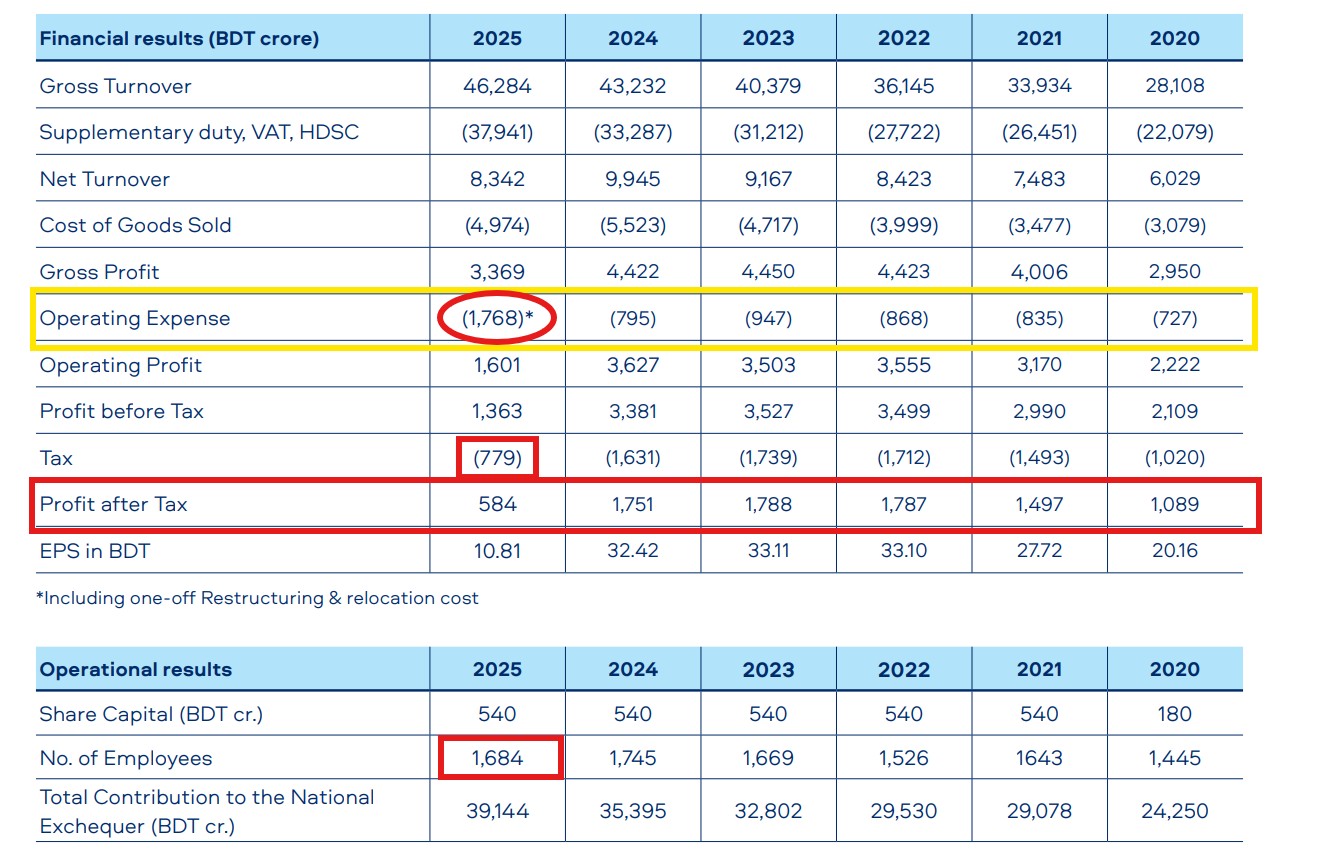
Around 77 percent of Bangladesh’s cigarette market is controlled by multinational company British American Tobacco Bangladesh (BATB). Another 12.21 percent belongs to Japan Tobacco International, while local company Abul Khair controls 10.28 percent. A few smaller domestic companies together account for less than 0.5 percent of total production. BATB’s profit figures alone are enough to demonstrate how profitable that “17 percent” actually is.
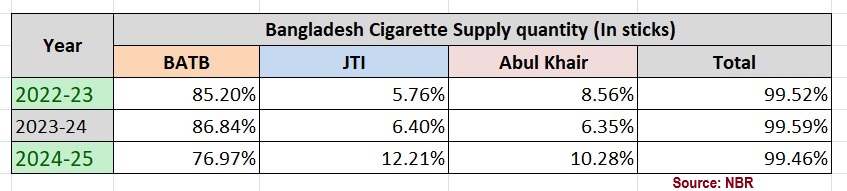
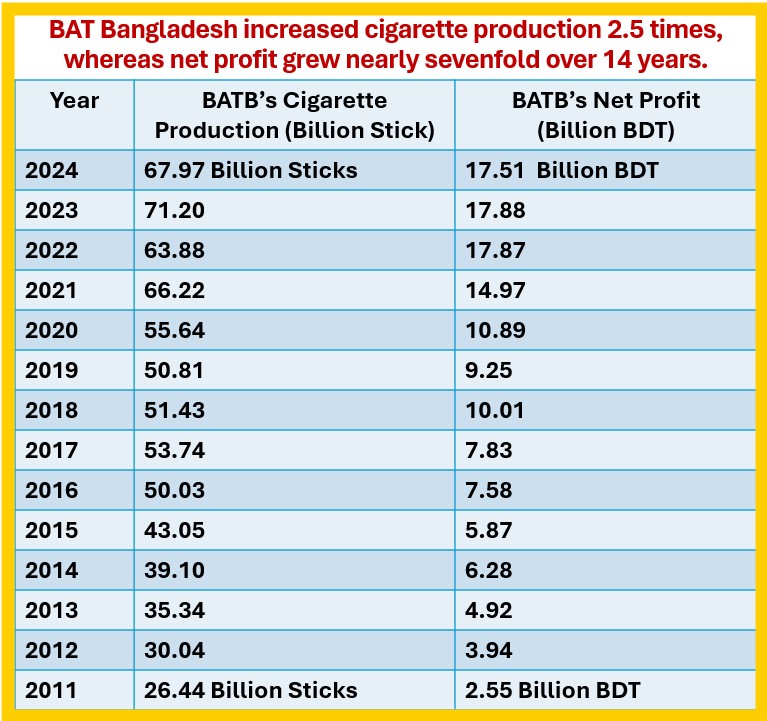
According to BATB’s annual reports, the company earned a net profit of Tk 10.89 billion in 2020, Tk 14.97 billion in 2021, Tk 17.12 billion in 2022, Tk 17.39 billion in 2023, and Tk 16.31 billion in 2024. That means BATB’s average annual net profit over the past five years exceeded Tk 15 billion. This is not rhetoric, it is reality. After accounting for tobacco leaf subsidies, procurement costs, cigarette manufacturing expenses, employee salaries, bank interest, operational costs, and corporate income taxes, BATB still generated more than Tk 15 billion in annual profit on average. And all of that came from the so-called “remaining 17 percent.”
BATB Reported Tk 7.21 billion in Factory Relocation Costs
In 2025, BATB reported net profit of Tk 5.84 billion. But that does not reflect the full picture. The company booked more than Tk 7.5 billion as the cost of relocating its cigarette factory from Mohakhali to Savar. This was not for purchasing new land or constructing an entirely new facility; it was shown primarily as relocation expenditure, raising serious questions about the justification for such an enormous amount. By booking these expenses, BATB substantially reduced its reported profits.
Had the actual relocation cost been closer to Tk 2 billion, BATB’s net profit would have increased by another Tk 5 billion, pushing total profits well above Tk 10 billion. Given this reality, can anyone still claim that tobacco companies cannot survive because they retain “only 17 percent”?
Just 5 Paisa More Per Stick Means Tk 2.5 billion in Extra Profit
Tobacco companies calculate profits not in taka, but in paisa-level margins. Even a 5 paisa increase in profit per cigarette stick can generate enormous earnings. Take BATB as an example. In 2025, the company produced 49.94 billion cigarette sticks. If profit rises by just 5 paisa per stick, BATB’s additional profit amounts to roughly Tk 2.5 billion. If profit increases by 10 paisa per stick, additional profit reaches nearly Tk 5 billion. With a 20 paisa increase per stick, profits approach Tk 10 billion.
Many people may think 5 or 10 paisa is insignificant. But for cigarette companies, these tiny increments translate into billions of taka in additional profit.
And this is only one company’s calculation. Across all cigarette companies combined, Bangladesh produced 65.42 billion cigarette sticks in FY 2024–25. If companies gain an additional 5 paisa profit per stick, total extra profit rises to Tk 3.27 billion. At 10 paisa per stick, profits exceed Tk 6.5 billion. This is why I have long argued that cigarette companies make enormous profits not through taka-level margins, but through paisa-level calculations.
So for those who remain concerned about the “mere 17 percent” retained by tobacco companies after taxes, the figures above should be more than enough.
For example, a Benson cigarette currently sells for Tk 18.5 per stick, including taxes, production costs, and company profit. After deducting taxes, only Tk 3.15 remains per stick to cover everything else — including production costs, company profit, commissions, bank interest, transportation, employee salaries, insurance, machinery, and corporate income tax. This is the reality: cigarettes are produced at extremely low cost. That is why British American Tobacco Bangladesh has consistently earned average annual post-tax profits exceeding Tk 15 billion in recent years.
Is the Upcoming Budget Creating More Opportunities for Tobacco Company Profits?
The upcoming FY 2026–27 budget may further fuel tobacco company profits through proposed cigarette price increases. The NBR chairman has already indicated that cigarette prices may rise by 15 to 20 percent across all categories. Tobacco companies are clearly pleased.
As mentioned earlier, even a 5 paisa increase in price can generate an additional Tk 2.5 billion in profits. If cigarette prices rise by Tk 1 per stick, and companies retain 17 percent of that increase, their profits could rise by more than Tk 5 billion.
However, if the government imposed a specific tax increase of Tk 1 per stick instead, the full amount would go directly to public revenue rather than corporate profit. Public health protection cannot succeed while simultaneously expanding opportunities for tobacco company profits. Greater profits simply encourage tobacco companies to expand their deadly business even further.
Author: Sushanta k Singha, Planning Editor, Ekattor Television, and Public Health Researcher
E-mail: sinhasmp@yahoo.com
