

Today, May 31, marks World No Tobacco Day, an annual observance dedicated to advancing public health and reducing the global burden of tobacco-related disease. The theme for World No Tobacco Day 2026 is “Unmask the Appeal – Countering Nicotine and Tobacco Addiction.”
At its core, the theme calls for exposing the tobacco industry’s business model, which profits from addiction and preventable deaths. Young people and adolescents must be made aware of the marketing tactics used by tobacco companies to attract new consumers. The younger a person becomes addicted to tobacco products, the more profitable they become for the industry.
For example, someone who begins smoking at the age of 15 may continue for 50 to 55 years, effectively becoming a guaranteed customer for half a century. The earlier nicotine addiction begins, the longer the potential revenue stream for tobacco companies. This is why the industry continues to promote cigarettes and, increasingly, newer products such as e-cigarettes and vaping devices. Young people remain a primary target.
Multinational Tobacco Companies Target Bangladesh’s Youth
Bangladesh is currently experiencing a significant demographic dividend. Approximately 66 percent of the population is between the ages of 15 and 64, forming the country’s working-age population. The remaining 34 percent consists of children and older adults who are generally dependent on others. This large working-age population represents one of Bangladesh’s greatest opportunities for economic growth.
However, multinational and domestic tobacco companies—including British American Tobacco, Japan Tobacco, and Philip Morris International—are employing increasingly sophisticated marketing strategies to attract this young demographic.
An estimated 200 million cigarettes are sold in Bangladesh every day. In addition, traditional tobacco products such as bidis, Smokeless tobacco products like Zarda, and Gul remain widely available. More recently, e-cigarettes, vaping devices, nicotine pouches, and other emerging nicotine products have entered the market.
E-Cigarettes and Vapes Are Not Harmless
Manufacturers often promote e-cigarettes and vaping products as less harmful alternatives to conventional cigarettes. However, these products can create new forms of nicotine dependence, particularly among young people who might otherwise never have used tobacco products.
One concerning development is the discussion of favorable tax treatment for products such as e-cigarettes, vaping devices, nicotine pouches, and heated tobacco products in the name of increasing government revenue. Public health advocates argue that these emerging nicotine products should be taxed at rates comparable to conventional cigarettes to discourage youth uptake and addiction.

Bangladesh Was a Pioneer in Global Tobacco Control
Bangladesh made history in 2003 by becoming the first country among 66 nations to sign the World Health Organization’s Framework Convention on Tobacco Control (FCTC). At the signing session, Bangladesh’s then Health Minister, Khandaker Mosharraf Hossain, presided over the proceedings.
The treaty was formally ratified in 2004. In 2005, Bangladesh enacted the Smoking and Tobacco Products Usage (Control) Act, placing the country among the early leaders in tobacco regulation in the developing world. The legislation was later amended twice to strengthen tobacco-control measures.
Bangladesh has also declared a goal of becoming tobacco-free by 2040. However, favorable treatment for newer nicotine products risks undermining that objective and creating new public health challenges.
Tobacco Cultivation Has Expanded Dramatically Following the Removal of Export Duties
Tobacco is unique in that its entire life cycle carries negative consequences. It harms public health, degrades the environment, and contributes little to food security.
The removal of export duties on tobacco leaves has significantly increased incentives for tobacco cultivation.
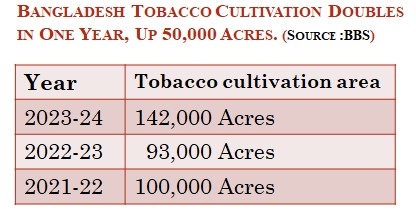
According to data from the Bangladesh Bureau of Statistics and the Department of Agricultural Marketing, tobacco cultivation covered approximately 93,000 acres during fiscal year 2023-24. In fiscal year 2024-25, that figure increased to around 142,000 acres an increase of nearly 50,000 acres within a single year.
One major factor behind this expansion is the elimination of export duties on tobacco leaves. Previously, exports were subject to a 25 percent duty, which was gradually reduced to zero, making tobacco cultivation more profitable and encouraging increased production.
Impact on Food Security
The expansion of tobacco cultivation has implications beyond public health. If the additional 50,000 acres used for tobacco cultivation in 2024-25 had instead been devoted to Boro rice production, Bangladesh could have produced an estimated 100,000 to 110,000 metric tons of rice.
At government procurement prices, that harvest would have been worth approximately BDT 3.6-3.96 billion (US$30–33 million) and could have met the annual food requirements of roughly 600,000-800,000 people.
Instead, valuable agricultural land is being diverted from food production to a crop associated with significant health and environmental costs.
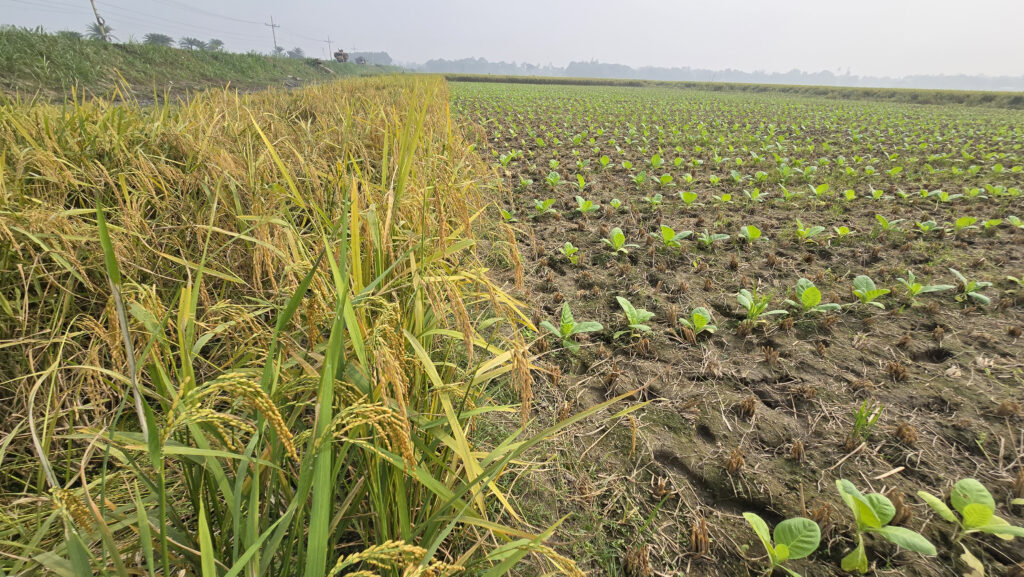
Tobacco farming requires substantial quantities of fertilizers and pesticides, which can reduce soil fertility over time. Tobacco curing also consumes large amounts of fuelwood, contributing to deforestation and environmental degradation.
Export Incentives and International Demand
Because of favorable export policies, tobacco leaves produced in Bangladesh are reportedly cheaper than those produced in neighboring countries such as India, Pakistan, and China. This enables multinational companies to source tobacco at lower costs and generate higher profits from cigarette manufacturing.
At the same time, both domestic and international companies benefit from tobacco-leaf exports. However, the economic gains must be weighed against the broader costs of tobacco-related disease, environmental damage, and reduced food production.
A Case for Restoring Export Duties
The removal of the previous 25 percent export duty on tobacco leaves has created incentives for further expansion of tobacco cultivation. Reinstating export duties could help reverse that trend.
The upcoming national budget presents an opportunity to introduce at least a 15 percent export duty on tobacco leaves, with a gradual increase to 25 percent in the following fiscal year. Such a policy would generate additional government revenue while discouraging further conversion of agricultural land to tobacco cultivation.
Restoring export duties would also support broader national objectives, including protecting agricultural land, strengthening food security, safeguarding public health, and reducing environmental harm.
At the same time, increasing taxes on tobacco products and emerging nicotine products remains one of the most effective policy tools available for reducing consumption, particularly among young people.
Conclusion
World No Tobacco Day serves as a reminder that tobacco control is not only a public health issue but also an economic, agricultural, and environmental challenge.
Bangladesh has long been recognized as a global leader in tobacco control. To maintain that leadership, policymakers should ensure that fiscal and trade policies align with the country’s public health commitments. Reinstating export duties on tobacco leaves, strengthening taxation of tobacco and nicotine products, and protecting young people from nicotine addiction would be important steps toward achieving the goal of a tobacco-free Bangladesh by 2040.
Sushanta Singha
Planning Editor, Ekattor Television, and Public Health Researcher
Read the original Bangla article here……
আসন্ন বাজেটে তামাকপাতা রপ্তানিতে অন্তত ১৫ শতাংশ শুল্ক আরোপ জরুরি
