
The Amsterdam-based Top Employers Institute grants its “Top Employer” recognition based on an evaluation of an organization’s workplace environment, human resources management, and policies and practices for employees. The multinational tobacco company British American Tobacco Bangladesh (BATB) has received this international recognition seven consecutive times. The company has publicized this achievement in various media outlets.
But as the saying goes, it’s darkest under the lamp — behind this recognition lies a very different picture of workers’ rights. Workers allege that for years, British American Tobacco Bangladesh has kept thousands of employees performing what are essentially permanent-nature jobs classified instead as third-party or outsourced workers. As a result, they are being denied the financial and legal benefits available to the company’s permanent staff.
Repeated Allegations of Labor Law Violations Against BAT Bangladesh
Under Bangladesh’s labor rules, contracting or outsourcing workers for an organization’s core or permanent-nature work is not permitted. If a task continues for more than 180 consecutive days in line with the nature of the organization, it is considered core or permanent work. Third-party or outsourced workers cannot be hired for such permanent work. Compliance with labor law is mandatory for all companies operating in Bangladesh, domestic or foreign.
Field Technicians (FTs) are involved in the entire tobacco cultivation process for the multinational cigarette company BAT Bangladesh. These field technicians handle farmer selection for tobacco cultivation, signing agreements with farmers, seed distribution, seedbed preparation, seedling care and monitoring, distribution of fertilizer and pesticides, disbursing cash loans, and providing field-level guidance for tobacco planting and cultivation.
That’s not all — after leaf collection, these field technician workers also handle curing, grading, preparing bales, issuing instructions (TPs) on when and how many bales a farmer should bring to sell to the company, and loan repayment matters. They also collect data through various BAT apps and provide field-level guidance to tobacco farmers.
According to the workers, they work in the field for about 10 months during the tobacco season. For the remaining two months, BATB assigns them to tree-planting or afforestation programs. In effect, they work for the company all 12 months of the year — yet they are not recognized as direct BAT employees.
Field Technicians Were Once Permanent Staff; Outsourcing Introduced to Deny Benefits
Field technicians perform all their work for BAT and follow instructions from BAT officials, yet their monthly salaries are paid through a company called MSM Logistics. Workers allege that BAT provides the salary funds to MSM Logistics, which then pays the FTs — while pocketing a large commission in between without doing any real work. In other words, the contracting company is profiting handsomely off workers’ hard-earned income.
In the Kushtia and Rangpur regions, BAT has strategically hired workers through a contracting company called MSM Logistics. In Chattogram, workers are employed through a different contracting firm. Workers allege that the owner of MSM Logistics once worked at BAT and, after retiring, started a long-term business supplying outsourced workers.
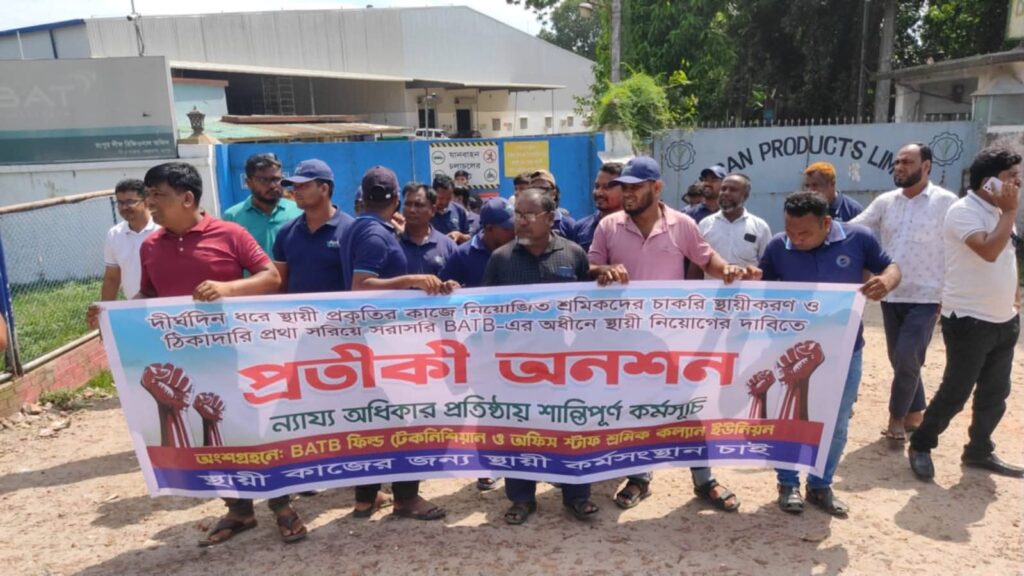
Workers involved in the protest allege that the multinational cigarette company is denying them fair wages and labor rights by paying commissions to contracting firms instead.
They claim that they have been connected to BAT for the past 16 years, since 2010. Despite performing the same kind of work regularly over this long period, they have been denied minimum job security, fair benefits, and the annual 5% profit share or WPPF (Workers’ Profit Participation Fund) mandated by labor law.
Field Technicians Are Permanent at Japan Tobacco, but Temporary at BAT
Protesting workers have also raised questions about the difference in how Japan Tobacco (JTI) manages the same type of field technician role compared to BAT. They claim that all field technicians at Japan Tobacco work as permanent employees and receive all benefits under the company’s policies, with significantly higher pay and allowances than BAT’s field technicians.
While Japan Tobacco controls about 12% of Bangladesh’s cigarette market, BAT controls roughly 77%. Workers ask: if JTI, with a market share more than six times smaller, can keep its field technicians as permanent employees, why can’t BAT Bangladesh do the same?
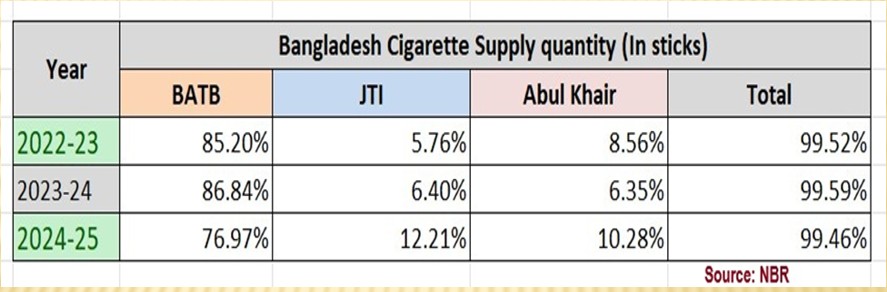
BAT also earns far higher profits. So are workers being cheated deliberately, with contractors used to fill permanent positions?
Workers allege that the positions they have long held were previously filled by BAT’s own permanent staff. Later, in pursuit of greater profit, the company shifted these positions under contracting or outsourcing arrangements.
Workers further allege that this practice of hiring through contractors increased significantly during the tenure of Shehzad Munim, the first Bangladeshi to be appointed Managing Director of BAT. They claim that, as a strategy to boost profits and prove his capability to BAT Group in the UK and Bangladesh, there is a pattern of repeated labor law violations during Munim’s tenure.
A Large Workforce Outside the Company’s Official Staff Structure
According to BAT Bangladesh’s 2025 annual report, the company’s total workforce is 1,685 people. Of these, 1,004 — nearly 60% — are shopfloor workers. There are also 366 junior staff, 236 mid-level staff, 70 senior staff, and 9 top management personnel. Yet, beyond these officially reported workers, more than 5,000 contracted workers are employed by the cigarette company across the country. Even at their cigarette factory in Savar alone, more than a thousand contracted workers are employed throughout the year — and they too are denied fair wages, year after year.
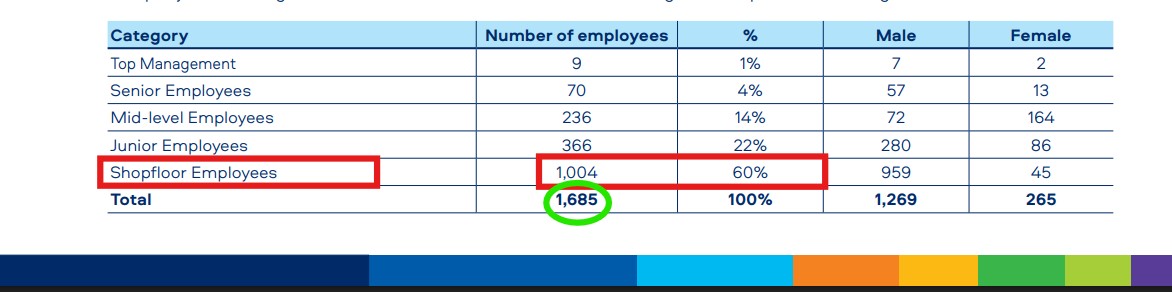
This means the scale of worker exploitation at the company is far larger than official figures suggest. Beyond the published workforce structure, a much larger number of workers are employed at the company’s factories and related operations — across more than 20 factories nationwide, including 12 in Kushtia — totaling more than 5,000 workers. Workers claim that many of them have been doing regular, permanent-type work for 15 to 20 years. But because they were hired through contractors or third parties, they remain outside BAT’s core staff structure.
This raises the question: if nearly 60% of the company’s total workforce is officially recognized as “Shopfloor Employees” in the annual report, why are so many workers who have long been engaged in production and related activities excluded from the company’s published staffing structure? Is BAT hiring contracted workers for permanent roles specifically to profit from commissions and deny labor rights?
An even bigger question arises: if an organization has received the “Top Employer” award seven consecutive times — recognition for workplace human resources management and protecting employee rights — yet a large share of the workers who have worked there for years are not even recognized as employees, how consistent is this international recognition with the reality on the ground?
Over 400 BAT Field Technicians Protest Demanding Permanent Jobs
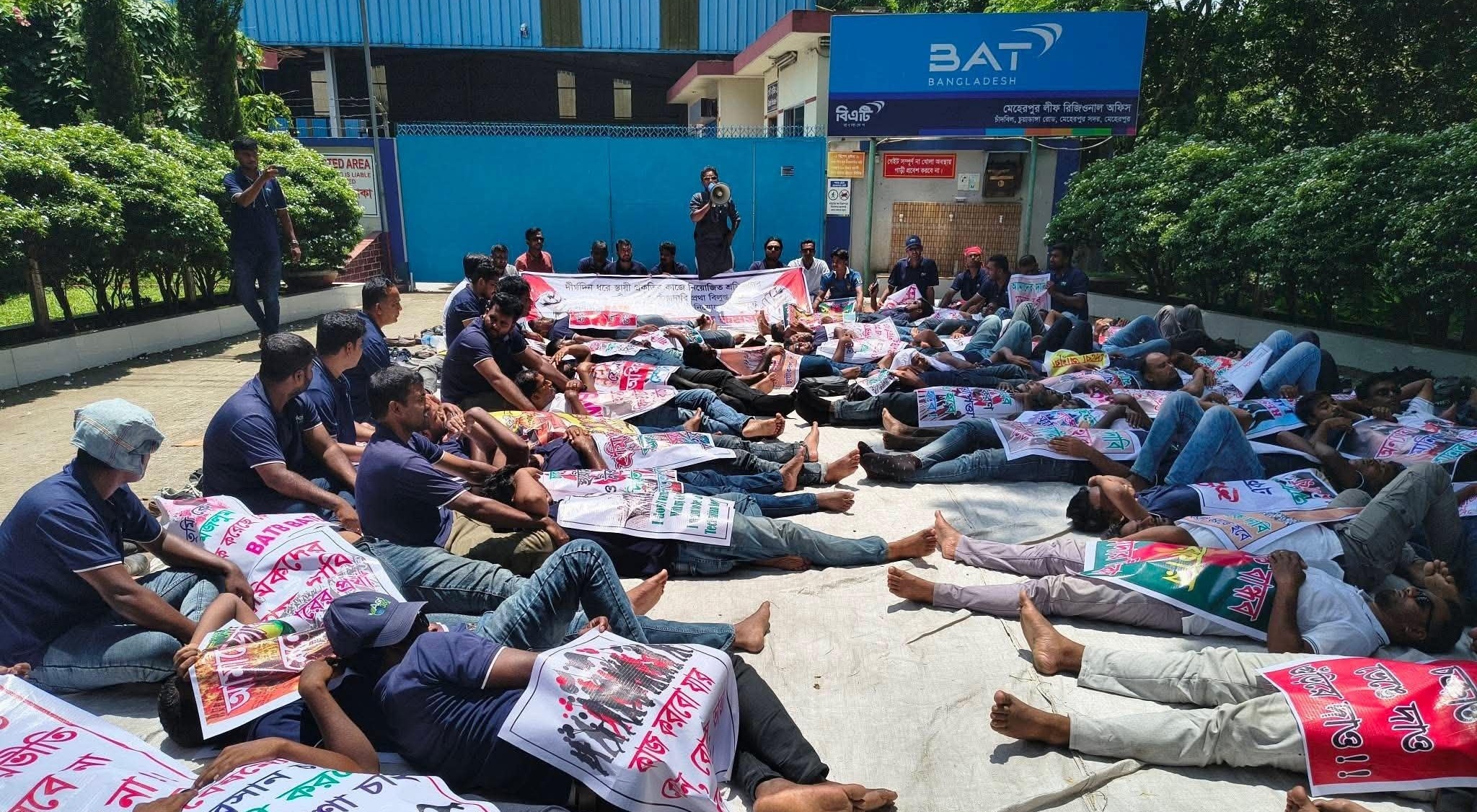
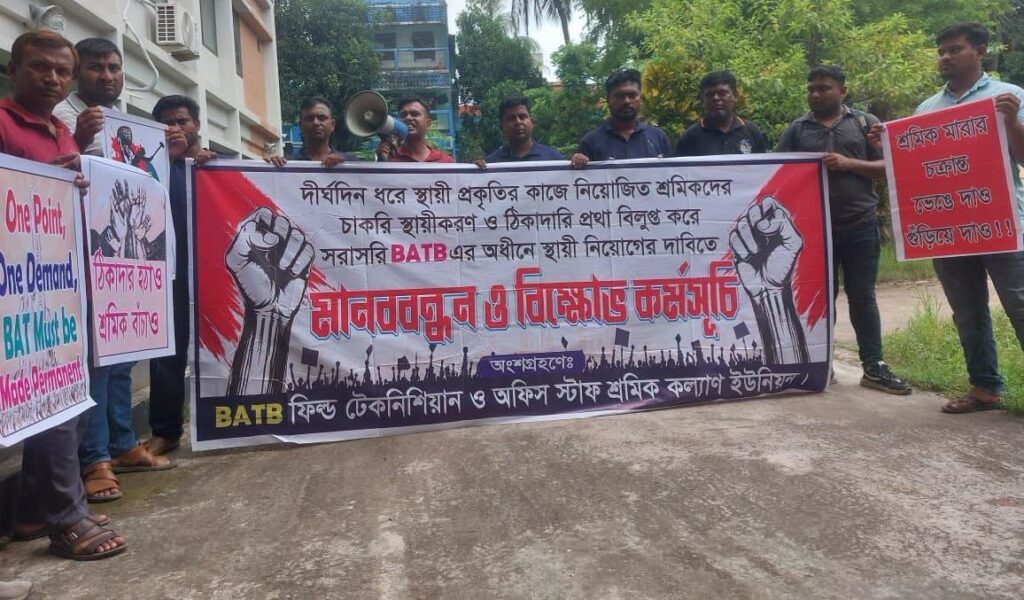
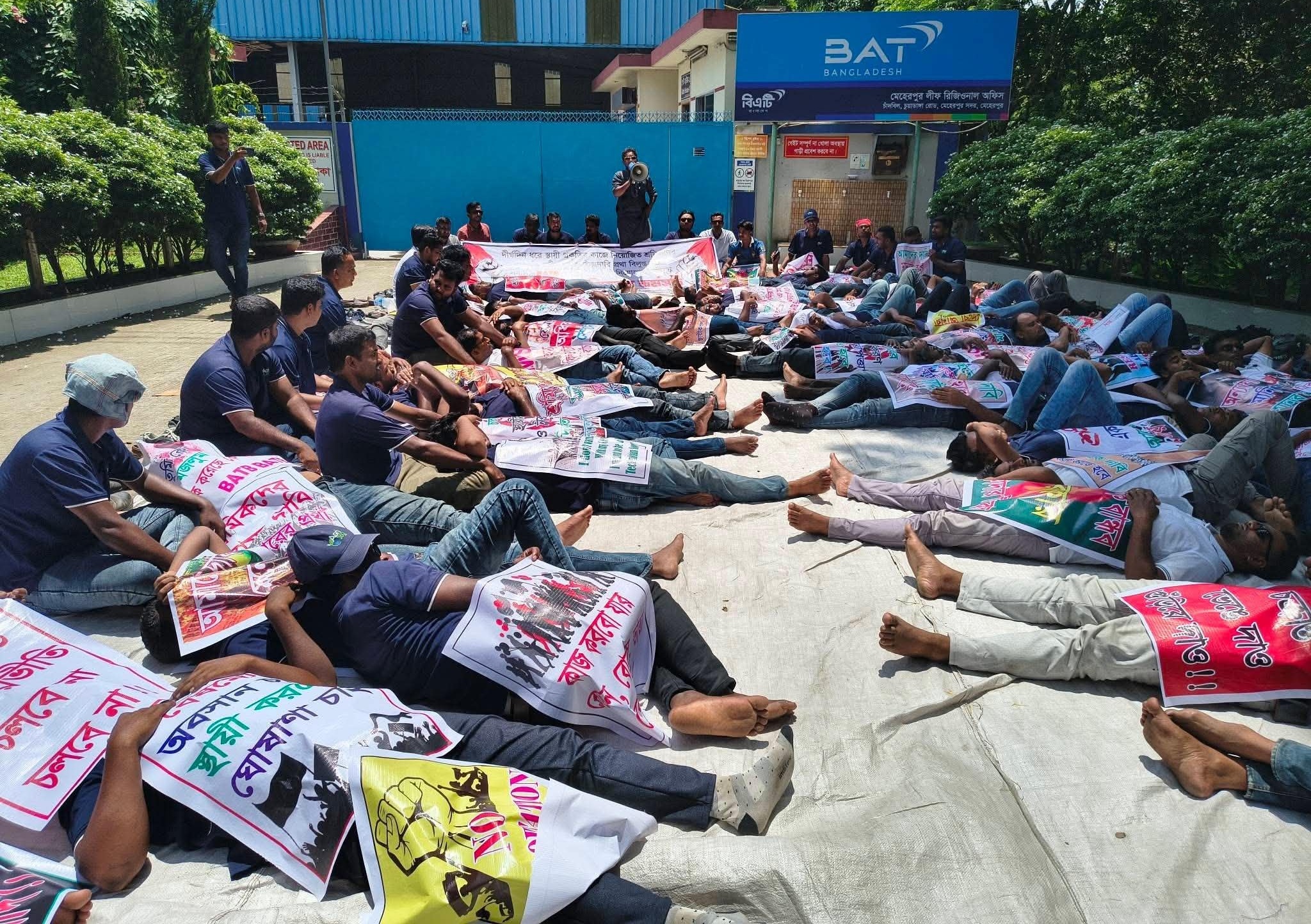
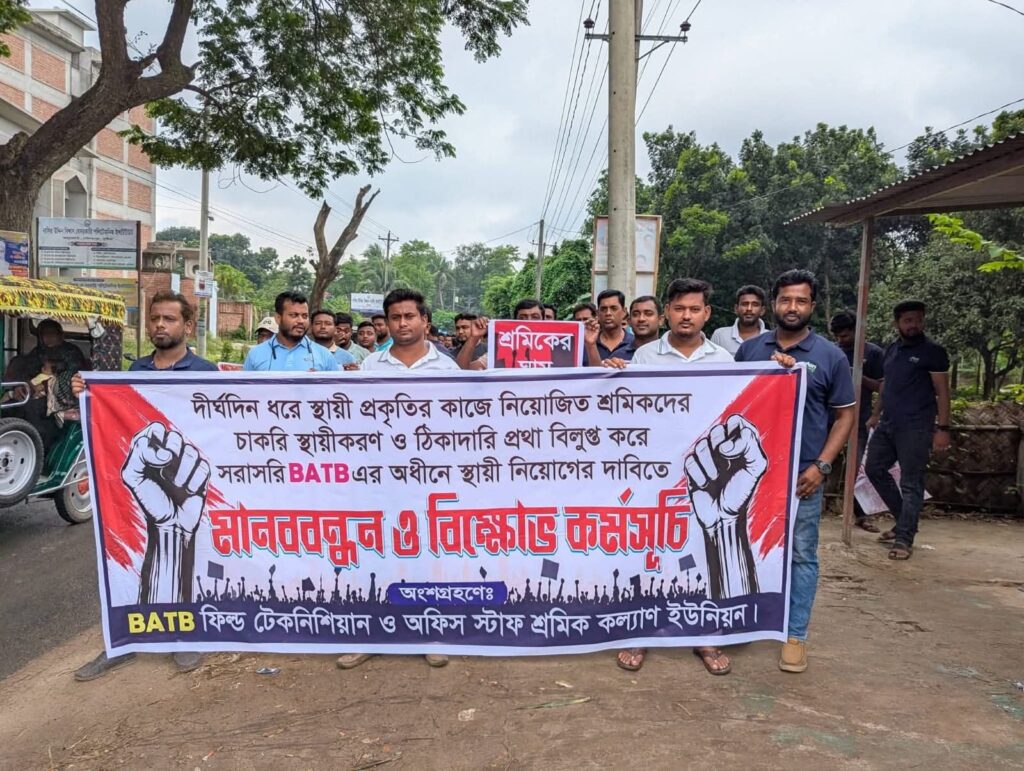
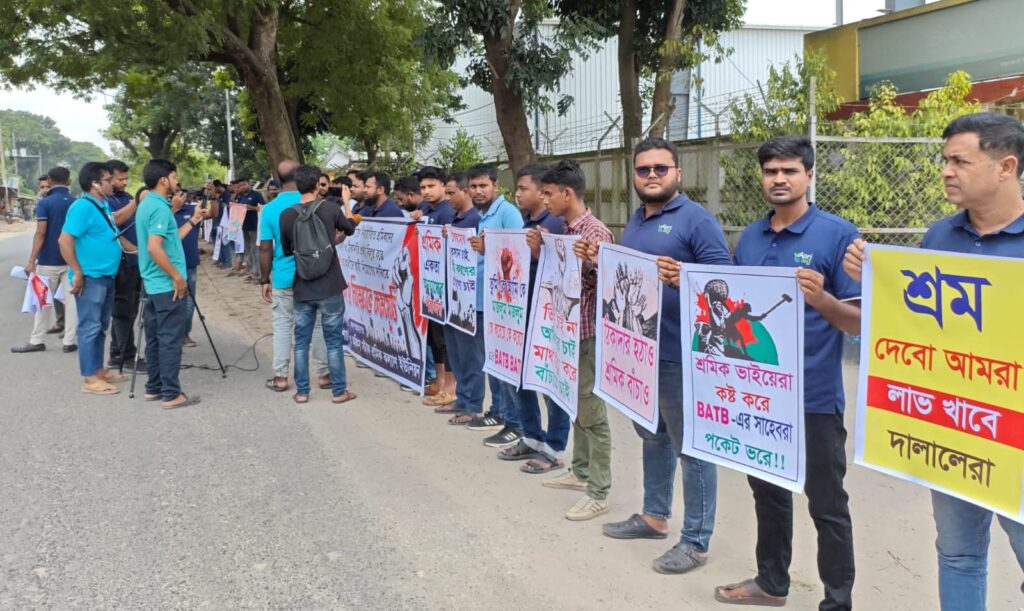
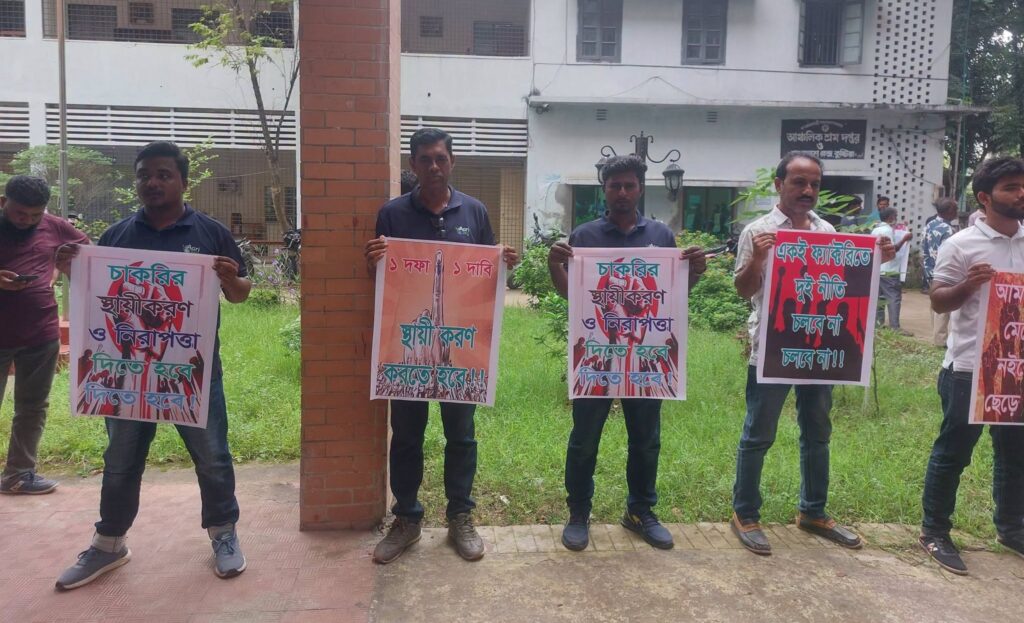
Demanding compliance with labor law and recognition as permanent employees, more than 400 field technicians have recently held marches, rallies, human chains, and sit-in strikes across BAT’s tobacco-growing regions, including Rangpur, Kushtia, Manikganj, Chuadanga, Jhenaidah, and Chattogram.
At a press conference held at the Kushtia Press Club on August 10, leaders of the Field Technician and Office Staff Workers’ Welfare Union said that workers across eight leaf regions – Kushtia, Rangpur, Manikganj, Allardarga, Chechuya, Meherpur, Jhenaidah, Chattogram North, and Chattogram South — are observing a work stoppage.
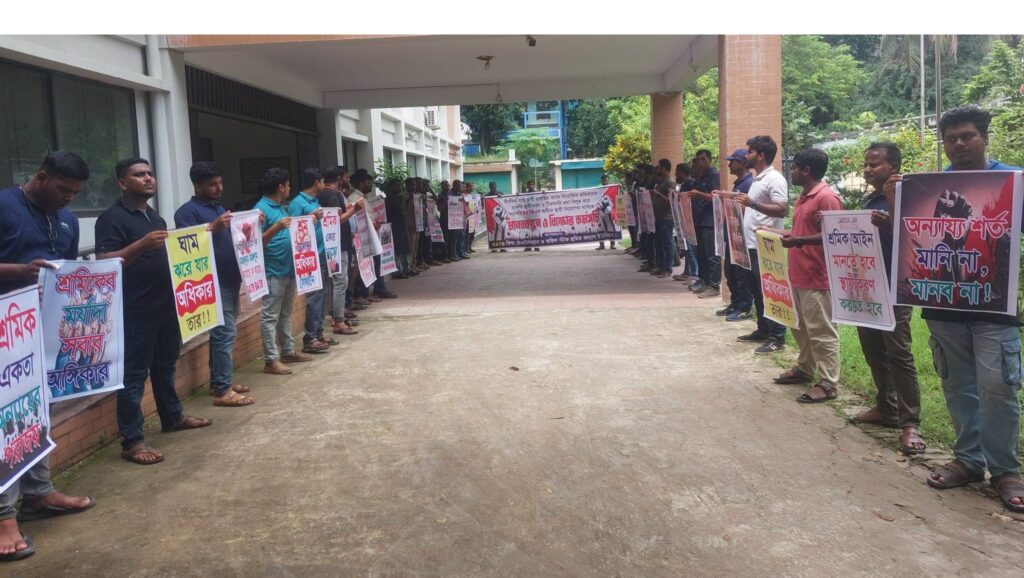
Earlier, on June 7, they submitted a written application to the respective Regional Managers. Later, on June 18, they submitted a written application to the Department of Inspection for Factories and Establishments (Labour Building). Copies were also sent to relevant authorities, the district administration, and the police superintendent.
Allegations of Transfers and Harassment After the Hearing
Following the workers’ application, a high-level hearing was held at the Rangpur Divisional Commissioner’s office on August 3. According to the workers, BAT’s DLM, Regional Managers, senior officials and their lawyers, as well as the chairman and director of the contracting firm MSM Logistics, were present. Workers claim that after legal arguments were presented at the hearing, management eventually acknowledged that the workers would be made permanent if the labor law allows it or if they secure their legal rights.
However, the protesting field technicians allege they faced retaliation soon after the hearing. Affected workers claim that 20 union leaders and active members were transferred to distant regions in an effort to break the movement’s morale. They describe this as “Unfair Labour Practice” under Section 195(d) of the Bangladesh Labour Act, 2006. They also allege that harassment complaints (General Diaries/GDs) were filed against 38 field technicians at Mirpur police station.
No Resolution Even After 17 Days of Work Stoppage
According to the workers, in protest of these transfers and threats, they held a peaceful work stoppage — seven days in the first phase and ten days in the second, totaling 17 days. As no effective resolution was reached, they began a third phase of a full 10-day work stoppage starting August 6.
The workers’ single demand is that their jobs be made permanent directly under BAT — not through contractors or intermediary firms. Field technicians and office staff have also demanded an end to dismissals, unpaid wages, and various forms of harassment and threats.
Workers have warned that if their demands are not met, they will escalate to blockades and other stricter actions across all regions nationwide. They have also called for urgent intervention from the Prime Minister, the Labour Minister, the Labour Secretary, and the Kushtia District Administrator.
Top Employer Award vs. Reality
On one hand, BAT Bangladesh has received the “Top Employer” recognition seven consecutive times for its workplace environment and human resources management. On the other hand, its field-level workers are protesting for recognition of their years of service, permanent employment, job security, and the benefits due to them under labor law.
This isn’t the first such dispute — seasonal workers at BAT’s JLT factory in Kushtia previously won a 22-day blockade protest, after which BAT Bangladesh was compelled to make the seasonal workers at the JLT factory permanent employees.
Given these allegations, a question naturally arises: why must workers who have served for years at an organization recognized internationally seven times over for good workplace practices and human resource management still have to protest for basic recognition as permanent employees?
This question has now become critical. How closely does the picture of BAT Bangladesh’s workplace, as portrayed through the “Top Employer” recognition, match the real-world experience of its field-level workers or is it simply a facade? If every other company can comply with Bangladesh’s labor law, why can’t British American Tobacco? I hope and believe that the Department of Inspection for Factories and Establishments (DIFE) will initiate an investigation as soon as possible to protect the rights and interests of the Field Technicians of BAT Bangladesh.
Author: Sushanta k Singha, public health researcher and journalist, sinhasmp@yahoo.com
শ্রম আইন লঙ্ঘনে শীর্ষে ৭ বার ‘টপ এমপ্লয়ার’ পুরস্কার পাওয়া বিএটি বাংলাদেশ
