
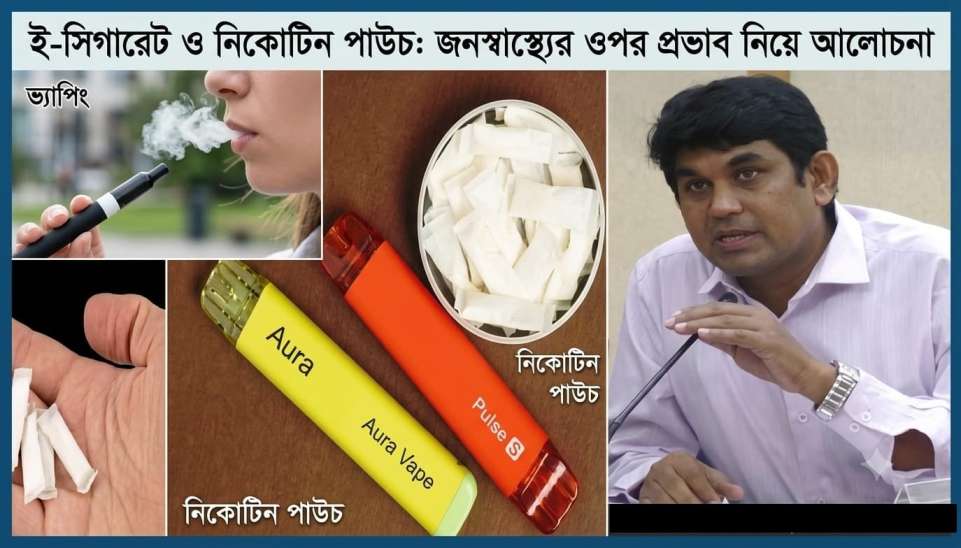
If the government’s justification for allowing e-cigarettes and heated tobacco products is revenue, why is it simultaneously cutting the taxes that could generate that revenue?
That is the question the government needs to answer. Bangladesh appears to be taking a significant policy U-turn on e-cigarettes, heated tobacco products (HTPs), and nicotine pouches. Products that were targeted for prohibition under an ordinance issued by the interim government have subsequently been allowed to remain in the market. At the same time, several proposed tax rates on these products and their raw materials have been reduced.
The government has cited revenue considerations in explaining the removal of restrictions on these products. But the subsequent tax concessions raise a troubling contradiction: if revenue is the rationale for legalization, why make the products cheaper to produce and import?
This is not merely a question of tax policy. It is a question of public health, transparency, and whose interest’s government policy ultimately serves.
From Prohibition to Permission
The policy shift is striking. The interim government introduced the Smoking and Tobacco Products Usage (Control) (Amendment) Ordinance, 2025, imposing restrictions on newer nicotine products, including heated tobacco products. The ordinance was gazette on December 30, 2025.
But after the national election, Parliament passed the Smoking and Tobacco Products Usage (Control) (Amendment) Bill, 2026 on April 10, 2026, after removing the provision banning heated tobacco products that had been included in the ordinance. On the same day, the health minister told Parliament that revenue considerations had been taken into account in removing the prohibition on e-cigarettes.
That explanation deserves closer scrutiny.
The health ministry exists primarily to protect public health. Yet in Parliament, revenue collection was cited as a consideration for allowing products that introduce new forms of nicotine consumption.
If revenue is the justification, then taxation should logically be central to the policy. Higher taxes can increase government revenue while simultaneously making addictive products less affordable, particularly for young people. Instead, what followed was a series of tax reductions.
The Tax Cuts That Raise Questions
Take nicotine pouches. The proposed supplementary duty was reduced from 40 percent to 35 percent. The budget also assigned a value of Tk 500 for 10 grams of nicotine pouches—an amount that anti-tobacco organizations say is considerably below prevailing market prices.
The figures for heated tobacco products raise similar concerns. The budget set the value of 10 sticks at Tk 210, while tobacco-control organizations claim that heated tobacco products, e-cigarettes, and vapes currently sell for Tk 500 or more. The reductions did not stop with finished products.
They extended to raw materials.
A 300 percent supplementary duty had been proposed on imported cigarette filters and cellulose acetate, a major component of filter production. For imports by tobacco companies, however, the rate was set at 100 percent. Then, through another SRO issued on the day the budget was passed, it was reduced further to just 30 percent.
The treatment of nicotine granules is equally striking. A 350 percent supplementary duty had initially been proposed on imports of nicotine granules, a raw material used to manufacture nicotine pouches. The rate for tobacco companies was subsequently set at 100 percent, and then reduced again to 60 percent.
These are not trivial adjustments. They go directly to the cost of manufacturing and importing products that public-health advocates say should be tightly controlled. So, the question becomes unavoidable. If the government wants revenue from these products, why reduce the taxes on them? And if the government wants to prevent young people from becoming addicted to nicotine, why make the products and their inputs less expensive?
Who Benefits from the SROs?
The Bangladesh Network for Tobacco Tax Policy (BNTTP) has alleged that the amended Finance Bill and subsequent SROs reflect proposals put forward by tobacco companies.
That is a serious allegation and should be investigated through the relevant documents, parliamentary records, submissions made during the budget process, and disclosures concerning industry-government engagement. But even without resolving that allegation, the policy sequence deserves public scrutiny. A government can legitimately decide to regulate rather than prohibit a product. It can also legitimately impose taxes on that product and collect revenue.
What becomes difficult to explain is a policy that cites revenue as a reason for allowing a product while simultaneously reducing the tax burden on that product and the raw materials used to manufacture it. That is where questions about policy coherence and influence begin.
A Young Population, a New Market
There is another dimension that Bangladesh cannot afford to overlook: its young population. The country’s demographic dividend has long been viewed as an economic opportunity. But from the perspective of the tobacco industry, a large young population also represents a vast potential consumer market.
Anti-tobacco organizations have alleged that multinational tobacco companies—including British American Tobacco, Philip Morris International, and Japan Tobacco International—are seeking to expand markets for heated tobacco products and nicotine pouches in Bangladesh. There have also been allegations of lobbying for favorable treatment in the import and production of these products.
The tobacco industry, for its part, has promoted newer nicotine products in various markets as alternatives to conventional cigarettes, often using the language of “harm reduction.”
But whatever position one takes on the relative risks of different nicotine products, one basic policy question remains: Should the government’s tax and regulatory framework make it easier for new nicotine products to reach a large young population? That question cannot be answered simply by pointing to potential tax revenue.
Revenue Is Not the Whole Story
There is an obvious attraction to the revenue argument. If people are going to consume a product anyway, the government can tax it and collect revenue. But public policy cannot be judged solely by the money collected at the point of sale. There are also potential downstream costs: nicotine dependence, increased consumption among young people, enforcement costs, healthcare expenditure, and the possibility that newer products may expand rather than replace conventional tobacco use.
These considerations do not automatically determine what Bangladesh’s policy should be. But they do mean that revenue must be weighed against public-health consequences. And if the government is going to use revenue as the justification for legalization, it should be able to explain why the tax structure appears to move in the opposite direction.
A Policy That Needs Answers
The government now faces a straightforward credibility test. If these products are being allowed because they can generate revenue, show the public the revenue strategy.
If taxation is intended to regulate consumption, explain why key tax rates have been reduced. If protecting young people is a priority, explain how the current tax and regulatory framework will prevent these products from becoming another pathway to nicotine addiction. And if tobacco companies have played a role in shaping these decisions, the public deserves transparency about who proposed what, who met whom, and how those proposals influenced the final policy.
Bangladesh has every right to design its own tobacco and nicotine policy. But that policy should be driven by transparent evidence and clearly stated public objectives—not by an unexplained contradiction between public-health commitments and fiscal decisions. The central issue is therefore no longer simply whether e-cigarettes, heated tobacco products, or nicotine pouches should be legal.
When the government says revenue justifies allowing new nicotine products, but then reduces the taxes imposed on those very products and their raw materials, whose interests are actually being served? That is a question the government owes the public a clear answer to.
