
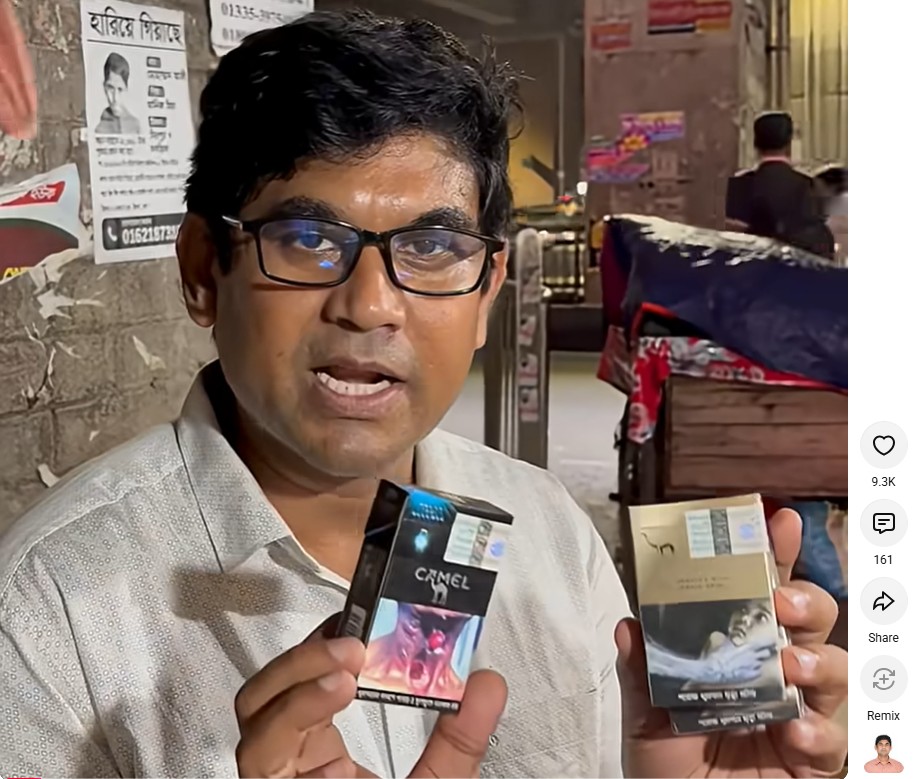
A Camel cigarette is sold for 10 taka per stick in Bangladesh. But have you ever stopped to think about how much that 10-taka Camel cigarette actually costs?
Recently, I published several pieces of content on my social media platforms about the actual price of Camel cigarettes and how cigarette prices are determined in Bangladesh. My objective was simple: to show people what actually goes into the price of the Camel cigarettes they buy every day.
What made me especially happy was the level of public interest. The video received nearly 491,000 views on my YouTube channel, while content on the same topic received more than 7 million views on my Facebook page.
But behind those numbers lies an even more important question: What exactly are people interested in knowing about the price of Camel cigarettes?
Let’s look at the numbers.
The maximum retail price, or MRP, of a 20-stick pack of Camel cigarettes in Bangladesh is 184 taka. That means the price per Camel cigarette should be 9 taka and 20 paisa. However, individual Camel cigarettes are often sold for 10 taka in the market. That means consumers are paying an additional 80 paisa per cigarette above the calculated per-stick MRP.
Now let’s come to the more important part. Out of a 10-taka Camel cigarette, how much is the actual price, and how much is tax? Have we ever really thought about that?
According to my calculation, if 83 percent of the total price is considered tax, then 8 taka and 30 paisa of a 10-taka Camel cigarette represents tax. That leaves only 1 taka and 70 paisa after excluding the tax component.
In other words, when we buy a Camel cigarette for 10 taka in Bangladesh, a significant portion of what we pay goes toward taxes. And this brings us to another important question.
Cigarette companies are often described as some of the largest taxpayers in Bangladesh. But who ultimately bears the economic burden of those taxes?
Yes, cigarette companies pay taxes to the government. But ultimately, that tax is collected through the price paid by cigarette consumers. The taxes are incorporated into the price of the product, and it is the consumer who ultimately bears that cost.
So, when a consumer pays 10 taka for a Camel cigarette, they are not simply paying for the cigarette itself. They are also paying the taxes incorporated into its selling price. That is exactly what I wanted to bring to the public’s attention through these videos.
Because, honestly, many people had never looked at Camel cigarettes this way. Many assumed that an expensive cigarette must have a very high production cost. Some even associated smoking expensive cigarettes with status or prestige.
But as consumers in Bangladesh, it is important for us to understand what we are actually paying for. My objective was never to attack anyone. It was simply to put a straightforward question in front of people:
When we pay 10 taka for a Camel cigarette in Bangladesh, how much of that 10 taka is actually the price of the cigarette—and how much is tax?
People have engaged with that question, discussed it, and started looking at the issue from a different perspective. And to me, that is the biggest achievement.
Because the success of content is not measured only by how many people watch it. If a piece of content about Camel cigarettes makes people stop, think, and ask questions, then that content has truly served its purpose.
